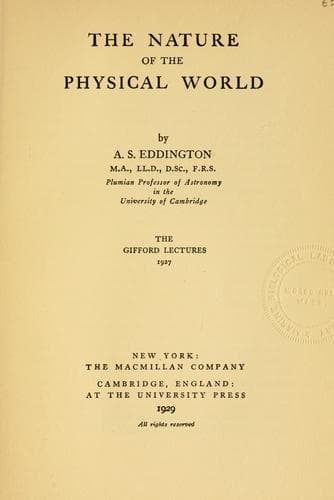
The nature of the physical worldEddington, Arthur Stanley, Sir
Philosophy
The nature of the physical world
Eddington, Arthur Stanley, Sir
Physics -- Philosophy; Science -- Philosophy
Besides the alteration of form there is actually a little difference
of substance between the two enunciations; the second corresponds to a
later and, it is believed, more accurate formula given by Einstein a
year or two after his first theory. The modification is made necessary
by our realisation that space is finite but unbounded (p. 80). The
second enunciation would be exactly equivalent to the first if for
“same constant length” we read “infinite length”. Apart from very
speculative estimates we do not know the constant length referred to,
but it must certainly be greater than the distance of the furthest
nebula, say miles. A distinction between so great a length
and infinite length is unnecessary in most of our arguments and
investigations, but it is necessary in the present chapter.
[Pg 140]
We must try to reach the vivid significance which lies behind the
obscure phraseology of the law. Suppose that you are ordering a concave
mirror for a telescope. In order to obtain what you want you will
have to specify two lengths (1) the aperture, and (2) the radius of
curvature. These lengths both belong to the mirror—both are necessary
to describe the kind of mirror you want to purchase—but they belong
to it in different ways. You may order a mirror of 100 foot radius of
curvature and yet receive it by parcel post. In a certain sense the 100
foot length travels with the mirror, but it does so in a way outside
the cognizance of the postal authorities. The 100 foot length belongs
especially to the surface of the mirror, a two-dimensional continuum;
space-time is a four-dimensional continuum, and you will see from this
analogy that there can be lengths belonging in this way to a chunk
of space-time—lengths having nothing to do with the largeness or
smallness of the chunk, but none the less part of the specification
of the particular sample. Owing to the two extra dimensions there
are many more such lengths associated with space-time than with the
mirror surface. In particular, there is not only one general radius of
spherical curvature, but a radius corresponding to any direction you
like to take. For brevity I will call this the “directed radius” of the
world. Suppose now that you order a chunk of space-time with a directed
radius of 500 trillion miles in one direction and 800 trillion miles in
another. Nature replies “No. We do not stock that. We keep a wide range
of choice as regards other details of specification; but as regards
directed radius we have nothing different in different directions, and
in fact all our goods have the one standard radius, trillion
miles.” I cannot tell you what number to put for because that is
still a secret of the firm.
[Pg 141]
Public-domain text, read in full here on John Shaqi.
Reviews
Reviews
No reviews yet
Be the first to share your thoughts on this work.
Elsewhere in the archive
Join the Discussion
Join the discussion
Sign in to leave a comment or review.
Sign InorCreate an account