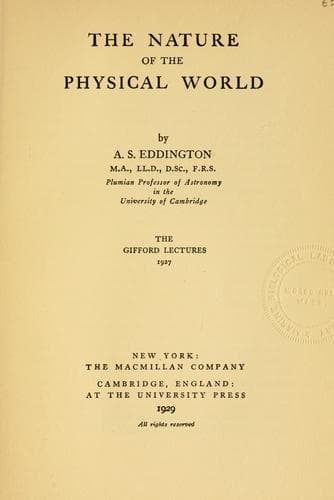
The nature of the physical worldEddington, Arthur Stanley, Sir
Philosophy
The nature of the physical world
Eddington, Arthur Stanley, Sir
Physics -- Philosophy; Science -- Philosophy
Great attention has lately been paid to the determination of the
temperature of the surface of Mars; it is possible to find this by
direct measurement of the heat radiated to us from different parts of
the surface. The results, though in many respects informative, are
scarcely accurate and accordant enough to give a definite idea of the
climatology. Naturally the temperature varies a great deal between day
and night and in different latitudes; but on the average the conditions
are decidedly chilly. Even at the equator the temperature falls below
freezing point at sunset. If we accepted the present determinations as
definitive we should have some doubt as to whether life could endure
the conditions.
In one of Huxley’s Essays there occurs the passage “Until human life
is longer and the duties of the present press less heavily I do not
think that wise men will occupy themselves with Jovian or Martian
natural history.” To-day it would seem that Martian natural history
is not altogether beyond the limits of serious science. At least the
surface of Mars shows a seasonal change such as we might well imagine
the forest-clad earth would show to an outside onlooker. This seasonal
change of appearance is very conspicuous to the attentive observer. As
the spring in one hemisphere advances (I mean, of course, the Martian
spring), the darker areas, which are at first few and faint, extend
and deepen in contrast. The same regions darken year after year at
[Pg 174]
nearly the same date in the Martian calendar. It may be that there is
an inorganic explanation; the spring rains moisten the surface and
change its colour. But it is perhaps unlikely that there is enough rain
to bring about this change as a direct effect. It is easier to believe
that we are witnessing the annual awakening of vegetation so familiar
on our own planet.
The existence of oxygen in the Martian atmosphere supplies another
argument in support of the existence of vegetable life. Oxygen combines
freely with many elements, and the rocks in the earth’s crust are
thirsty for oxygen. They would in course of time bring about its
complete disappearance from the air, were it not that the vegetation
extracts it from the soil and sets it free again. If oxygen in the
terrestrial atmosphere is maintained in this way, it would seem
reasonable to assume that vegetable life is required to play the same
part on Mars. Taking this in conjunction with the evidence of the
seasonal changes of appearance, a rather strong case for the existence
of vegetation seems to have been made out.
Public-domain text, read in full here on John Shaqi.
Reviews
Reviews
No reviews yet
Be the first to share your thoughts on this work.
Elsewhere in the archive
Join the Discussion
Join the discussion
Sign in to leave a comment or review.
Sign InorCreate an account