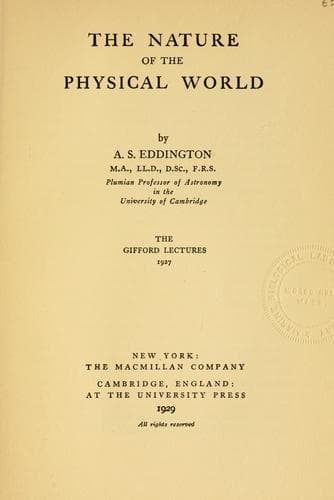
The nature of the physical worldEddington, Arthur Stanley, Sir
Philosophy
The nature of the physical world
Eddington, Arthur Stanley, Sir
Physics -- Philosophy; Science -- Philosophy
If vegetable life must be admitted, can we exclude animal life? I have
come to the end of the astronomical data and can take no responsibility
for anything further that you may infer. It is true that the late
Prof. Lowell argued that certain more or less straight markings on the
planet represent an artificial irrigation system and are the signs of
an advanced civilisation; but this theory has not, I think, won much
support. In justice to the author of this speculation it should be said
that his own work and that of his observatory have made a magnificent
contribution to our knowledge of Mars; but few would follow him all
the way on the more picturesque side of his conclusions.[30] Finally
[Pg 175]
we may stress one point. Mars has every appearance of being a planet
long past its prime; and it is in any case improbable that two planets
differing so much as Mars and the Earth would be in the zenith of
biological development contemporaneously.
Formation of Planetary Systems. If the planets of the solar
system should fail us, there remain some thousands of millions of
stars which we have been accustomed to regard as suns ruling attendant
systems of planets. It has seemed a presumption, bordering almost
on impiety, to deny to them life of the same order of creation as
ourselves. It would indeed be rash to assume that nowhere else in the
universe has Nature repeated the strange experiment which she has
performed on the earth. But there are considerations which must hold us
back from populating the universe too liberally.
On examining the stars with a telescope we are surprised to find how
many of those which appear single points to the eye are actually two
stars close together. When the telescope fails to separate them the
spectroscope often reveals two stars in orbital revolution round each
other. At least one star in three is double—a pair of self-luminous
globes both comparable in dimensions with the sun. The single supreme
sun is accordingly not the only product of evolution; not much less
frequently the development has taken another turn and resulted in two
suns closely associated. We may probably rule out the possibility
of planets in double stars. Not only is there a difficulty in
[Pg 176]
ascribing to them permanent orbits under the more complicated field
of gravitation, but a cause for the formation of planets seems to be
lacking. The star has satisfied its impulse to fission in another
manner; it has divided into two nearly equal portions instead of
throwing off a succession of tiny fragments.
Public-domain text, read in full here on John Shaqi.
Reviews
Reviews
No reviews yet
Be the first to share your thoughts on this work.
Elsewhere in the archive
Join the Discussion
Join the discussion
Sign in to leave a comment or review.
Sign InorCreate an account