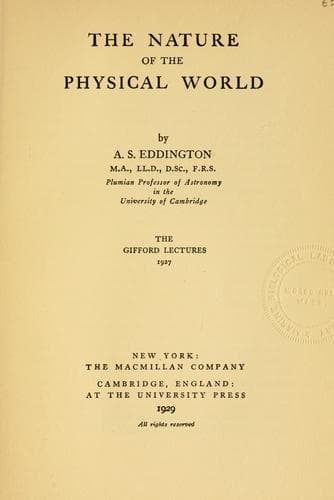
The nature of the physical worldEddington, Arthur Stanley, Sir
Philosophy
The nature of the physical world
Eddington, Arthur Stanley, Sir
Physics -- Philosophy; Science -- Philosophy
We must, of course, look forward to an ultimate reconstruction of
our conceptions of the physical world which will embrace both the
classical laws and the quantum laws in harmonious association. There
are still some who think that the reconciliation will be effected by
a development of classical conceptions. But the physicists of what I
may call “the Copenhagen school” believe that the reconstruction has
to start at the other end, and that in the quantum phenomena we are
getting down to a more intimate contact with Nature’s way of working
than in the coarse-grained experience which has furnished the classical
laws. The classical school having become convinced of the existence of
these uniform lumps of action, speculates on the manufacture of the
chopper necessary to carve off uniform lumps; the Copenhagen school on
the other hand sees in these phenomena the insubstantial pageant of
space, time and matter crumbling into grains of action. I do not think
that the Copenhagen school has been mainly influenced by the immense
difficulty of constructing a satisfactory chopper out of classical
material; its view arises especially from a study of the meeting point
of quantum and classical laws.
The classical laws are the limit to which the quantum laws tend when
states of very high quantum number are concerned.
[Pg 196]
This is the famous Correspondence Principle enunciated by Bohr. It
was at first a conjecture based on rather slight hints; but as our
knowledge of quantum laws has grown, it has been found that when we
apply them to states of very high quantum number they converge to the
classical laws, and predict just what the classical laws would predict.
For an example, take a hydrogen atom with its electron in a circular
orbit of very high quantum number, that is to say far away from the
proton. On Monday, Wednesday and Friday it is governed by classical
laws. These say that it must emit a feeble radiation continuously, of
strength determined by the acceleration it is undergoing and of period
agreeing with its own period of revolution. Owing to the gradual loss
of energy it will spiral down towards the proton. On Tuesday, Thursday
and Saturday it is governed by quantum laws and jumps from one orbit
to another. There is a quantum law that I have not mentioned which
prescribes that (for circular orbits only) the jump must always be to
the circular orbit next lower, so that the electron comes steadily down
the series of steps without skipping any. Another law prescribes the
average time between each jump and therefore the average time between
the successive emissions of light. The small lumps of energy cast away
at each step form light-waves of period determined by the rule.
“Preposterous! You cannot seriously mean that the electron does
different things on different days of the week!”
Public-domain text, read in full here on John Shaqi.
Reviews
Reviews
No reviews yet
Be the first to share your thoughts on this work.
Elsewhere in the archive
Join the Discussion
Join the discussion
Sign in to leave a comment or review.
Sign InorCreate an account