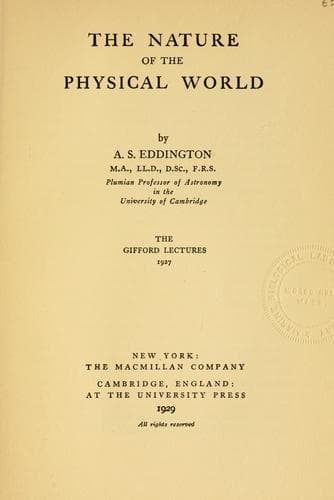
The nature of the physical worldEddington, Arthur Stanley, Sir
Philosophy
The nature of the physical world
Eddington, Arthur Stanley, Sir
Physics -- Philosophy; Science -- Philosophy
But did I say that it does different things? I used different words
to describe its doings. I run down the stairs on Tuesday and slide
down the banisters on Wednesday; but if the staircase consists of
innumerable infinitesimal steps, there is no essential difference in
[Pg 197]
my mode of progress on the two days. And so it makes no difference
whether the electron steps from one orbit to the next lower or comes
down in a spiral when the number of steps is innumerably great. The
succession of lumps of energy cast overboard merges into a continuous
outflow. If you had the formulae before you, you would find that the
period of the light and the strength of radiation are the same whether
calculated by the Monday or the Tuesday method—but only when the
quantum number is infinitely great. The disagreement is not very
serious when the number is moderately large; but for small quantum
numbers the atom cannot sit on the fence. It has to decide between
Monday (classical) and Tuesday (quantum) rules. It chooses Tuesday
rules.
If, as we believe, this example is typical, it indicates one direction
which the reconstruction of ideas must take. We must not try to build
up from classical conceptions, because the classical laws only become
true and the conceptions concerned in them only become defined in the
limiting case when the quantum numbers of the system are very large.
We must start from new conceptions appropriate to low as well as to
high numbered states; out of these the classical conceptions should
emerge, first indistinctly, then definitely, as the number of the
state increases, and the classical laws become more and more nearly
true. I cannot foretell the result of this remodelling, but presumably
room must be found for a conception of “states”, the unity of a state
replacing the kind of tie expressed by classical forces. For low
numbered states the current vocabulary of physics is inappropriate;
at the moment we can scarcely avoid using it, but the present
contradictoriness of our theories arises from this misuse. For such
[Pg 198]
states space and time do not exist—at least I can see no reason to
believe that they do. But it must be supposed that when high numbered
states are considered there will be found in the new scheme approximate
counterparts of the space and time of current conception—something
ready to merge into space and time when the state numbers are infinite.
And simultaneously the interactions described by transitions of states
will merge into classical forces exerted across space and time. So
that in the limit the classical description becomes an available
alternative. Now in practical experience we have generally had to deal
with systems whose ties are comparatively loose and correspond to very
high quantum numbers; consequently our first survey of the world has
stumbled across the classical laws and our present conceptions of the
world consist of those entities which only take definite shape for high
quantum numbers.
Public-domain text, read in full here on John Shaqi.
Reviews
Reviews
No reviews yet
Be the first to share your thoughts on this work.
Elsewhere in the archive
Join the Discussion
Join the discussion
Sign in to leave a comment or review.
Sign InorCreate an account