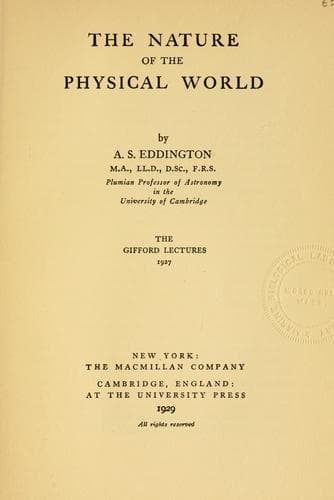
The nature of the physical worldEddington, Arthur Stanley, Sir
Philosophy
The nature of the physical world
Eddington, Arthur Stanley, Sir
Physics -- Philosophy; Science -- Philosophy
But in the interior of the atom and molecule, in the
phenomena of radiation, and probably also in the constitution of very
dense stars such as the Companion of Sirius, the state numbers are not
high enough to admit this treatment. These phenomena are now forcing
us back to the more fundamental conceptions out of which the classical
conceptions (sufficient for the other types of phenomena) ought to
emerge as one extreme limit.
For an example I will borrow a quantum conception from the next chapter.
It may not be destined to survive in the present rapid
evolution of ideas, but at any rate it will illustrate my point. In
Bohr’s semi-classical model of the hydrogen atom there is an electron
describing a circular or elliptic orbit. This is only a model; the real
atom contains nothing of the sort. The real atom contains something
[Pg 199]
which it has not entered into the mind of man to conceive, which has,
however, been described symbolically by Schrödinger. This “something”
is spread about in a manner by no means comparable to an electron
describing an orbit. Now excite the atom into successively higher and
higher quantum states. In the Bohr model the electron leaps into higher
and higher orbits. In the real atom Schrödinger’s “something” begins to
draw itself more and more together until it begins sketchily to outline
the Bohr orbit and even imitates a condensation running round. Go on to
still higher quantum numbers, and Schrödinger’s symbol now represents
a compact body moving round in the same orbit and the same period as
the electron in Bohr’s model, and moreover radiating according to the
classical laws of an electron. And so when the quantum number reaches
infinity, and the atom bursts, a genuine classical electron flies out.
The electron, as it leaves the atom, crystallises out of Schrödinger’s
mist like a genie emerging from his bottle.
[31]
Prof. E. T. Whittaker.
[32]
Since the rule is now well established the energies
of different states of the atoms are usually calculated by its aid; to
use these to test the rule would be a vicious circle.
[Pg 200]
Chapter X
THE NEW QUANTUM THEORY
The conflict between quantum theory and classical theory becomes
especially acute in the problem of the propagation of light. Here in
effect it becomes a conflict between the corpuscular theory of light
and the wave theory.
Public-domain text, read in full here on John Shaqi.
Reviews
Reviews
No reviews yet
Be the first to share your thoughts on this work.
Elsewhere in the archive
Join the Discussion
Join the discussion
Sign in to leave a comment or review.
Sign InorCreate an account