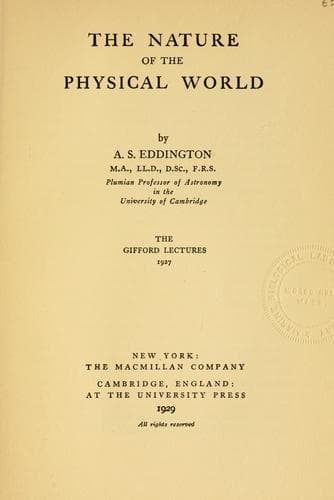
The nature of the physical worldEddington, Arthur Stanley, Sir
Philosophy
The nature of the physical world
Eddington, Arthur Stanley, Sir
Physics -- Philosophy; Science -- Philosophy
It is, however, an advantage not to pass from wave-frequency to
classical energy at this stage, but to follow the course of events in
the sub-aether a little farther. It would be difficult to think of
the electron as having two energies (i.e. being in two Bohr orbits)
simultaneously; but there is nothing to prevent waves of two different
frequencies being simultaneously present in the sub-aether. Thus
the wave-theory allows us easily to picture a condition which the
classical theory could only describe in paradoxical terms. Suppose
that two sets of waves are present. If the difference of frequency is
not very great the two systems of waves will produce “beats”. If two
broadcasting stations are transmitting on wave-lengths near together
we hear a musical note or shriek resulting from the beats of the two
carrier waves; the individual oscillations are too rapid to affect the
ear, but they combine to give beats which are slow enough to affect
the ear. In the same way the individual wave-systems in the sub-aether
are composed of oscillations too rapid to affect our gross senses;
but their beats are sometimes slow enough to come within the octave
[Pg 216]
covered by the eye. These beats are the source of the light coming
from the hydrogen atom, and mathematical calculation shows that their
frequencies are precisely those of the observed light from hydrogen.
Heterodyning of the radio carrier waves produces sound; heterodyning
of the sub-aethereal waves produces light. Not only does this theory
give the periods of the different lines in the spectra, but it also
predicts their intensities—a problem which the older quantum theory
had no means of tackling. It should, however, be understood that the
beats are not themselves to be identified with light-waves; they are
in the sub-aether, whereas light-waves are in the aether. They provide
the oscillating source which in some way not yet traced sends out
light-waves of its own period.
What precisely is the entity which we suppose to be oscillating when
we speak of the waves in the sub-aether? It is denoted by ,
and properly speaking we should regard it as an elementary indefinable
of the wave-theory. But can we give it a classical interpretation of
any kind? It seems possible to interpret it as a probability. The
probability of the particle or electron being within a given region
is proportional to the amount of in that region. So that
if is mainly concentrated in one small stormy area, it is
practically certain that the electron is there; we are then able to
localise it definitely and conceive of it as a classical particle. But
the -waves of the hydrogen atom are spread about all over the
atom; and there is no definite localisation of the electron, though
some places are more probable than others.[36]
[Pg 217]
Public-domain text, read in full here on John Shaqi.
Reviews
Reviews
No reviews yet
Be the first to share your thoughts on this work.
Elsewhere in the archive
Join the Discussion
Join the discussion
Sign in to leave a comment or review.
Sign InorCreate an account