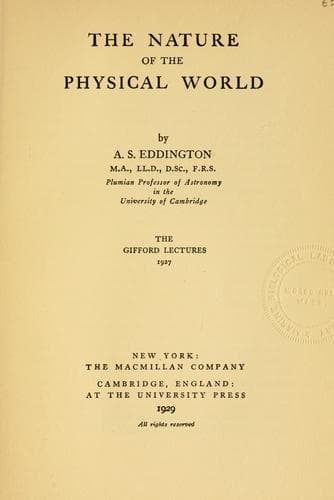
The nature of the physical worldEddington, Arthur Stanley, Sir
Philosophy
The nature of the physical world
Eddington, Arthur Stanley, Sir
Physics -- Philosophy; Science -- Philosophy
Attention must be called to one highly important consequence of this
theory. A small enough stormy area corresponds very nearly to a
particle moving about under the classical laws of motion; it would
seem therefore that a particle definitely localised as a moving point
is strictly the limit when the stormy area is reduced to a point. But
curiously enough by continually reducing the area of the storm we
never quite reach the ideal classical particle; we approach it and
then recede from it again. We have seen that the wave-group moves like
a particle (localised somewhere within the area of the storm) having
an energy corresponding to the frequency of the waves; therefore to
imitate a particle exactly, not only must the area be reduced to a
point but the group must consist of waves of only one frequency. The
two conditions are irreconcilable. With one frequency we can only
have an infinite succession of waves not terminated by any boundary.
A boundary to the group is provided by interference of waves of
slightly different length, so that while reinforcing one another at
the centre they cancel one another at the boundary. Roughly speaking,
if the group has a diameter of 1000 wave-lengths there must be a range
of wave-length of 0.1 per cent., so that 1000 of the longest waves
and 1001 of the shortest occupy the same distance. If we take a more
concentrated stormy area of diameter 10 wave-lengths the range is
[Pg 218]
increased to 10 per cent.; 10 of the longest and 11 of the shortest
waves must extend the same distance. In seeking to make the position
of the particle more definite by reducing the area we make its energy
more vague by dispersing the frequencies of the waves. So our particle
can never have simultaneously a perfectly definite position and a
perfectly definite energy; it always has a vagueness of one kind or the
other unbefitting a classical particle. Hence in delicate experiments
we must not under any circumstances expect to find particles behaving
exactly as a classical particle was supposed to do—a conclusion which
seems to be in accordance with the modern experiments on diffraction of
electrons already mentioned.
We remarked that Schrödinger’s picture of the hydrogen atom enabled
it to possess something that would be impossible on Bohr’s theory,
viz. two energies at once. For a particle or electron this is not
merely permissive, but compulsory—otherwise we can put no limits to
the region where it may be. You are not asked to imagine the state of
a particle with several energies; what is meant is that our current
picture of an electron as a particle with single energy has broken
down, and we must dive below into the sub-aether if we wish to follow
the course of events. The picture of a particle may, however, be
retained when we are not seeking high accuracy; if we do not need to
know the energy more closely than 1 per cent., a series of energies
ranging over 1 per cent, can be treated as one definite energy.
Public-domain text, read in full here on John Shaqi.
Reviews
Reviews
No reviews yet
Be the first to share your thoughts on this work.
Elsewhere in the archive
Join the Discussion
Join the discussion
Sign in to leave a comment or review.
Sign InorCreate an account