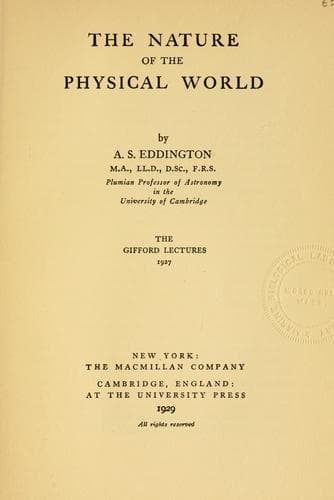
The nature of the physical worldEddington, Arthur Stanley, Sir
Philosophy
The nature of the physical world
Eddington, Arthur Stanley, Sir
Physics -- Philosophy; Science -- Philosophy
Principle of Indeterminacy. My apprehension lest a fourth
version of the new quantum theory should appear before the lectures
were delivered was not fulfilled; but a few months later the theory
definitely entered on a new phase. It was Heisenberg again who set in
motion the new development in the summer of 1927, and the consequences
were further elucidated by Bohr. The outcome of it is a fundamental
general principle which seems to rank in importance with the principle
of relativity. I shall here call it the “principle of indeterminacy”.
The gist of it can be stated as follows: a particle may have
position or it may have velocity but it cannot in any exact sense have
both.
If we are content with a certain margin of inaccuracy and if we
are content with statements that claim no certainty but only high
probability, then it is possible to ascribe both position and velocity
to a particle. But if we strive after a more accurate specification
of position a very remarkable thing happens; the greater accuracy can
be attained, but it is compensated by a greater inaccuracy in the
specification of the velocity. Similarly if the specification of the
velocity is made more accurate the position becomes less determinate.
[Pg 221]
Suppose for example that we wish to know the position and velocity of
an electron at a given moment. Theoretically it would be possible to
fix the position with a probable error of about ¹⁄₁₀₀₀ of a millimetre
and the velocity with a probable error of 1 kilometre per second. But
an error of ¹⁄₁₀₀₀ of a millimetre is large compared with that of
some of our space measurements; is there no conceivable way of fixing
the position to ¹⁄₁₀₀₀₀ of a millimetre? Certainly; but in that case
it will only be possible to fix the velocity with an error of 10
kilometres per second.
The conditions of our exploration of the secrets of Nature are
such that the more we bring to light the secret of position the
more the secret of velocity is hidden. They are like the old man
and woman in the weather-glass; as one comes out of one door, the
other retires behind the other door. When we encounter unexpected
obstacles in finding out something which we wish to know, there are
two possible courses to take. It may be that the right course is to
treat the obstacle as a spur to further efforts; but there is a second
possibility—that we have been trying to find something which does
not exist. You will remember that that was how the relativity theory
accounted for the apparent concealment of our velocity through the
aether.
Public-domain text, read in full here on John Shaqi.
Reviews
Reviews
No reviews yet
Be the first to share your thoughts on this work.
Elsewhere in the archive
Join the Discussion
Join the discussion
Sign in to leave a comment or review.
Sign InorCreate an account