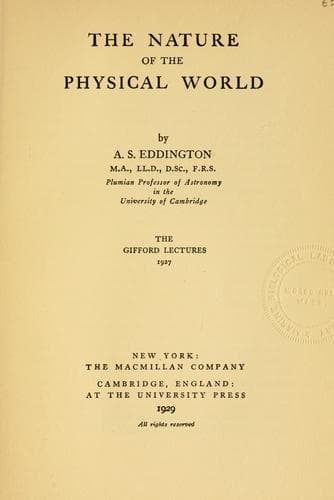
The nature of the physical worldEddington, Arthur Stanley, Sir
Philosophy
The nature of the physical world
Eddington, Arthur Stanley, Sir
Physics -- Philosophy; Science -- Philosophy
It means that we have been aiming at a false ideal of a complete
description of the world. There has not yet been time to make serious
search for a new epistemology adapted to these conditions. It has
become doubtful whether it will ever be possible to construct a
physical world solely out of the knowable—the guiding principle in
our macroscopic theories. If it is possible, it involves a great
upheaval of the present foundations. It seems more likely that we
must be content to admit a mixture of the knowable and unknowable.
This means a denial of determinism, because the data required for
a prediction of the future will include the unknowable elements of
the past. I think it was Heisenberg who said, “The question whether
from a complete knowledge of the past we can predict the future,
does not arise because a complete knowledge of the past involves a
[Pg 229]
self-contradiction.”
It is only through a quantum action that the outside world can interact
with ourselves and knowledge of it can reach our minds. A quantum
action may be the means of revealing to us some fact about Nature,
but simultaneously a fresh unknown is implanted in the womb of Time.
An addition to knowledge is won at the expense of an addition to
ignorance. It is hard to empty the well of Truth with a leaky bucket.
[33]
The evidence is much stronger now than when the lectures
were delivered.
[34]
The energy is required because on cooling down the matter
must regain a more normal density and this involves a great expansion
of volume of the star. In the expansion work has to be done against the
force of gravity.
[35]
Each orbit or state of the atom requires three (or, for
later refinements, four) quantum numbers to define it. The first two
quantum numbers are correctly represented in the Bohr model; but the
third number which discriminates the different lines forming a doublet
or multiplet spectrum is represented wrongly—a much more serious
failure than if it were not represented at all.
[36]
The probability is often stated to be proportional
to instead of , as assumed above. The whole
interpretation is very obscure, but it seems to depend on whether you
are considering the probability after you know what has happened
or the probability for the purposes of prediction. The
is obtained by introducing two symmetrical systems of -waves
travelling in opposite directions in time; one of these must presumably
correspond to probable inference from what is known (or is stated) to
have been the condition at a later time. Probability necessarily means
“probability in the light of certain given information”, so that the
probability cannot possibly be represented by the same function in
different classes of problems with different initial data.
[Pg 230]
Chapter XI
WORLD BUILDING
Public-domain text, read in full here on John Shaqi.
Reviews
Reviews
No reviews yet
Be the first to share your thoughts on this work.
Elsewhere in the archive
Join the Discussion
Join the discussion
Sign in to leave a comment or review.
Sign InorCreate an account