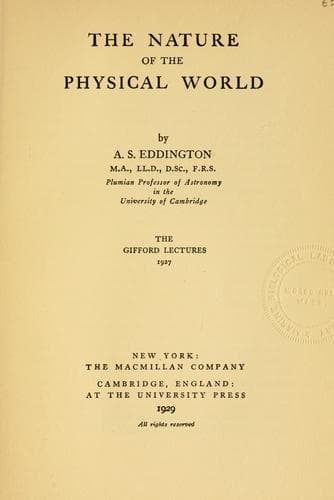
The nature of the physical worldEddington, Arthur Stanley, Sir
Philosophy
The nature of the physical world
Eddington, Arthur Stanley, Sir
Physics -- Philosophy; Science -- Philosophy
We have an intricate task before us. We are going to build a World—a
physical world which will give a shadow performance of the drama
enacted in the world of experience. We are not very expert builders
as yet; and you must not expect the performance to go off without a
hitch or to have the richness of detail which a critical audience might
require. But the method about to be described seems to give the bold
outlines; doubtless we have yet to learn other secrets of the craft of
world building before we can complete the design.
The first problem is the building material. I remember that as an
impecunious schoolboy I used to read attractive articles on how
to construct wonderful contrivances out of mere odds and ends.
Unfortunately these generally included the works of an old clock, a
few superfluous telephones, the quicksilver from a broken barometer,
and other oddments which happened not to be forthcoming in my lumber
room. I will try not to let you down like that. I cannot make the
world out of nothing, but I will demand as little specialised material
as possible. Success in the game of World Building consists in the
greatness of the contrast between the specialised properties of the
completed structure and the unspecialised nature of the basal material.
Relation Structure. We take as building material
relations and relata. The relations unite the relata; the
relata are the meeting points of the relations. The one is unthinkable
[Pg 231]
apart from the other. I do not think that a more general starting-point
of structure could be conceived.
To distinguish the relata from one another we assign to them
monomarks. The monomark consists of four numbers ultimately to
be called “co-ordinates”. But co-ordinates suggest space and geometry
and as yet there is no such thing in our scheme; hence for the present
we shall regard the four identification numbers as no more than an
arbitrary monomark. Why four numbers? We use four because it
turns out that ultimately the structure can be brought into better
order that way; but we do not know why this should be so. We have got
so far as to understand that if the relations insisted on a threefold
or a fivefold ordering it would be much more difficult to build
anything interesting out of them; but that is perhaps an insufficient
excuse for the special assumption of fourfold order in the primitive
material.
Public-domain text, read in full here on John Shaqi.
Reviews
Reviews
No reviews yet
Be the first to share your thoughts on this work.
Elsewhere in the archive
Join the Discussion
Join the discussion
Sign in to leave a comment or review.
Sign InorCreate an account