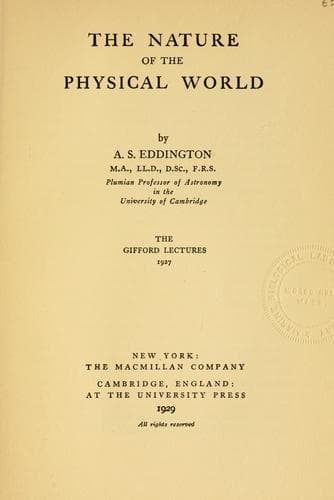
The nature of the physical worldEddington, Arthur Stanley, Sir
Philosophy
The nature of the physical world
Eddington, Arthur Stanley, Sir
Physics -- Philosophy; Science -- Philosophy
The element of permanence in the physical world, which is familiarly
represented by the conception of substance, is essentially a
contribution of the mind to the plan of building or selection. We can
see this selective tendency at work in a comparatively simple problem,
[Pg 242]
viz. the hydrodynamical theory of the ocean. At first sight the problem
of what happens when the water is given some initial disturbance
depends solely on inorganic laws; nothing could be more remote from
the intervention of conscious mind. In a sense this is true; the
laws of matter enable us to work out the motion and progress of the
different portions of the water; and there, so far as the inorganic
world is concerned, the problem might be deemed to end. But actually in
hydrodynamical textbooks the investigation is diverted in a different
direction, viz. to the study of the motions of waves and wave-groups.
The progress of a wave is not progress of any material mass of water,
but of a form which travels over the surface as the water heaves up
and down; again the progress of a wave-group is not the progress of a
wave. These forms have a certain degree of permanence amid the shifting
particles of water. Anything permanent tends to become dignified with
an attribute of substantiality. An ocean traveller has even more
vividly the impression that the ocean is made of waves than that it is
made of water.[39] Ultimately it is this innate hunger for permanence
in our minds which directs the course of development of hydrodynamics,
and likewise directs the world-building out of the sixteen measures of
structure.
Perhaps it will be objected that other things besides mind can
appreciate a permanent entity such as mass; a weighing machine can
appreciate it and move a pointer to indicate how much mass there is. I
do not think that is a valid objection. In building the physical world
we must of course build the measuring appliances which are part of it;
[Pg 243]
and the measuring appliances result from the plan of building in the
same way as the entities which they measure. If, for example, we had
used some of the “lumber” to build an entity , we could presumably
construct from the same lumber an appliance for measuring . The
difference is this—if the pointer of the weighing machine is reading 5
lbs. a human consciousness is in a mysterious way (not yet completely
traced) aware of the fact, whereas if the measuring appliance for
reads 5 units no human mind is aware of it. Neither nor the
appliance for measuring have any interaction with consciousness.
Thus the responsibility for the fact that the scheme of the scientific
world includes mass but excludes rests ultimately with the
phenomena of consciousness.
Public-domain text, read in full here on John Shaqi.
Reviews
Reviews
No reviews yet
Be the first to share your thoughts on this work.
Elsewhere in the archive
Join the Discussion
Join the discussion
Sign in to leave a comment or review.
Sign InorCreate an account