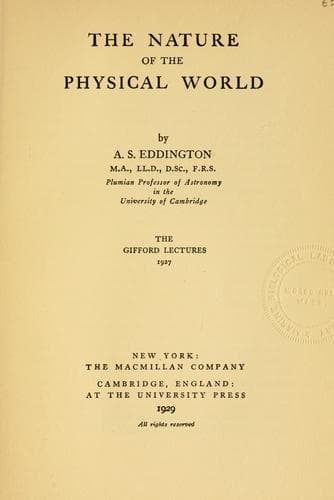
The nature of the physical worldEddington, Arthur Stanley, Sir
Philosophy
The nature of the physical world
Eddington, Arthur Stanley, Sir
Physics -- Philosophy; Science -- Philosophy
Perhaps a better way of expressing this selective influence of mind
on the laws of Nature is to say that values are created by
the mind. All the “light and shade” in our conception of the world
of physics comes in this way from the mind, and cannot be explained
without reference to the characteristics of consciousness.
The world which we have built from the relation-structure is no doubt
doomed to be pulled about a good deal as our knowledge progresses. The
quantum theory shows that some radical change is impending. But I think
that our building exercise has at any rate widened our minds to the
possibilities and has given us a different orientation towards the idea
of physical law. The points which I stress are:
Firstly, a strictly quantitative science can arise from a basis which
is purely qualitative. The comparability that has to be assumed
axiomatically is a merely qualitative discrimination of likeness and
unlikeness.
Secondly, the laws which we have hitherto regarded as the most typical
[Pg 244]
natural laws are of the nature of truisms, and the ultimate controlling
laws of the basal structure (if there are any) are likely to be of a
different type from any yet conceived.
Thirdly, the mind has by its selective power fitted the processes of
Nature into a frame of law of a pattern largely of its own choosing;
and in the discovery of this system of law the mind may be regarded as
regaining from Nature that which the mind has put into Nature.
Three Types of Law. So far as we are able to judge, the laws
of Nature divide themselves into three classes: (1) identical laws,
(2) statistical laws, (3) transcendental laws. We have just been
considering the identical laws, i.e. the laws obeyed as mathematical
identities in virtue of the way in which the quantities obeying them
are built. They cannot be regarded as genuine laws of control of the
basal material of the world. Statistical laws relate to the behaviour
of crowds, and depend on the fact that although the behaviour of each
individual may be extremely uncertain average results can be predicted
with confidence. Much of the apparent uniformity of Nature is a
uniformity of averages. Our gross senses only take cognisance of the
average effect of vast numbers of individual particles and processes;
and the regularity of the average might well be compatible with a great
degree of lawlessness of the individual. I do not think it is possible
to dismiss statistical laws (such as the second law of thermodynamics)
as merely mathematical adaptations of the other classes of law to
certain practical problems. They involve a peculiar element of their
own connected with the notion of a priori probability; but we
do not yet seem able to find a place for this in any of the current
[Pg 245]
conceptions of the world substratum.
Public-domain text, read in full here on John Shaqi.
Reviews
Reviews
No reviews yet
Be the first to share your thoughts on this work.
Elsewhere in the archive
Join the Discussion
Join the discussion
Sign in to leave a comment or review.
Sign InorCreate an account