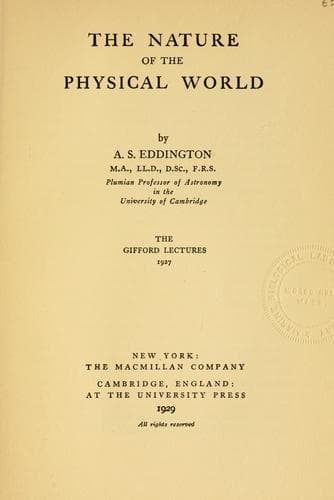
The nature of the physical worldEddington, Arthur Stanley, Sir
Philosophy
The nature of the physical world
Eddington, Arthur Stanley, Sir
Physics -- Philosophy; Science -- Philosophy
phenomena they have always proved spurious, the apparent determinism
having come about in another way. Therefore we are inclined to regard
favourably the possibility that there may be no causal marks anywhere.
But, it will be said, it is inconceivable that an atom can be so evenly
balanced between two alternative courses that nowhere in the world as
yet is there any trace of the ultimately deciding factor. This is an
appeal to intuition and it may fairly be countered with another appeal
to intuition. I have an intuition much more immediate than any relating
to the objects of the physical world; this tells me that nowhere in the
world as yet is there any trace of a deciding factor as to whether I am
going to lift my right hand or my left. It depends on an unfettered act
of volition not yet made or foreshadowed.[48] My intuition is that the
future is able to bring forth deciding factors which are not secretly
hidden in the past.
The position is that the laws governing the microscopic elements of
the physical world—individual atoms, electrons, quanta—do not make
definite predictions as to what the individual will do next. I am
[Pg 303]
here speaking of the laws that have been actually discovered and
formulated on the old quantum theory and the new. These laws indicate
several possibilities in the future and state the odds on each. In
general the odds are moderately balanced and are not tempting to an
aspiring prophet. But short odds on the behaviour of individuals
combine into very long odds on suitably selected statistics of a
number of individuals; and the wary prophet can find predictions of
this kind on which to stake his credit—without serious risk. All the
successful predictions hitherto attributed to causality are traceable
to this. It is quite true that the quantum laws for individuals are
not incompatible with causality; they merely ignore it. But if we take
advantage of this indifference to reintroduce determinism at the basis
of world structure it is because our philosophy predisposes us that
way, not because we know of any experimental evidence in its favour.
We might for illustration make a comparison with the doctrine of
predestination. That theological doctrine, whatever may be said against
it, has hitherto seemed to blend harmoniously with the predetermination
of the material universe. But if we were to appeal to the new
conception of physical law to settle this question by analogy the
answer would be:—The individual is not predestined to arrive at either
of the two states, which perhaps may here be sufficiently discriminated
as State 1 and State 2; the most that can be considered already settled
is the respective odds on his reaching these states.
Public-domain text, read in full here on John Shaqi.
Reviews
Reviews
No reviews yet
Be the first to share your thoughts on this work.
Elsewhere in the archive
Join the Discussion
Join the discussion
Sign in to leave a comment or review.
Sign InorCreate an account