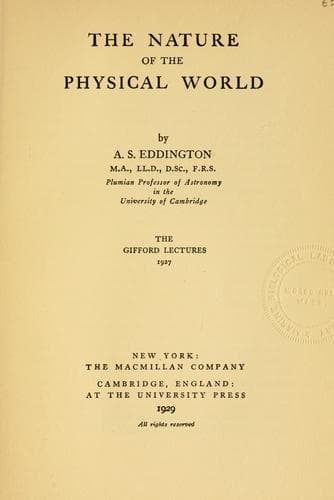
The nature of the physical worldEddington, Arthur Stanley, Sir
Philosophy
The nature of the physical world
Eddington, Arthur Stanley, Sir
Physics -- Philosophy; Science -- Philosophy
Let us look more closely into the problem of how the mind gets a grip
on material atoms so that movements of the body and limbs can be
controlled by its volition. I think we may now feel quite satisfied
that the volition is genuine. The materialist view was that the motions
which appear to be caused by our volition are really reflex actions
controlled by the material processes in the brain, the act of will
being an inessential side phenomenon occurring simultaneously with
the physical phenomena. But this assumes that the result of applying
physical laws to the brain is fully determinate. It is meaningless to
say that the behaviour of a conscious brain is precisely the same as
that of a mechanical brain if the behaviour of a mechanical brain is
left undetermined. If the laws of physics are not strictly causal the
most that can be said is that the behaviour of the conscious brain is
one of the possible behaviours of a mechanical brain. Precisely so; and
the decision between the possible behaviours is what we call volition.
Perhaps you will say, When the decision of an atom is made between its
possible quantum jumps, is that also “volition”? Scarcely; the analogy
is altogether too remote. The position is that both for the brain and
the atom there, is nothing in the physical world, i.e. the world of
pointer readings, to predetermine the decision; the decision is a fact
of the physical world with consequences in the future but not causally
connected to the past. In the case of the brain we have an insight into
a mental world behind the world of pointer readings and in that world
we get a new picture of the fact of decision which must be taken as
revealing its real nature—if the words real nature have any
meaning. For the atom we have no such insight into what is behind the
[Pg 312]
pointer readings. We believe that behind all pointer readings there is
a background continuous with the background of the brain; but there is
no more ground for calling the background of the spontaneous behaviour
of the atom “volition” than for calling the background of its causal
behaviour “reason”. It should be understood that we are not attempting
to reintroduce in the background the strict causality banished from the
pointer readings. In the one case in which we have any insight—the
background of the brain—we have no intention of giving up the freedom
of the mind and will. Similarly we do not suggest that the marks of
predestination of the atom, not found in the pointer readings, exist
undetectable in the unknown background. To the question whether I
would admit that the cause of the decision of the atom has something
in common with the cause of the decision of the brain, I would simply
answer that there is no cause. In the case of the brain I have a deeper
insight into the decision; this insight exhibits it as volition, i.e.
something outside causality.
Public-domain text, read in full here on John Shaqi.
Reviews
Reviews
No reviews yet
Be the first to share your thoughts on this work.
Elsewhere in the archive
Join the Discussion
Join the discussion
Sign in to leave a comment or review.
Sign InorCreate an account