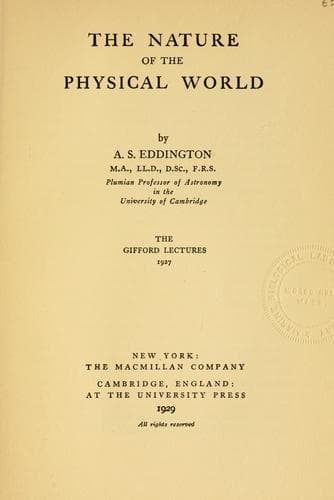
The nature of the physical worldEddington, Arthur Stanley, Sir
Philosophy
The nature of the physical world
Eddington, Arthur Stanley, Sir
Physics -- Philosophy; Science -- Philosophy
A mental decision to turn right or turn left starts one of two
alternative sets of impulses along the nerves to the feet. At some
brain centre the course of behaviour of certain atoms or elements
of the physical world is directly determined for them by the mental
decision—or, one may say, the scientific description of that behaviour
is the metrical aspect of the decision. It would be a possible though
difficult hypothesis to assume that very few atoms (or possibly only
one atom) have this direct contact with the conscious decision, and
that these few atoms serve as a switch to deflect the material world
from one course to the other. But it is physically improbable that
[Pg 313]
each atom has its duty in the brain so precisely allotted that the
control of its behaviour would prevail over all possible irregularities
of the other atoms. If I have at all rightly understood the processes
of my own mind, there is no finicking with individual atoms.
I do not think that our decisions are precisely balanced on the conduct
of certain key-atoms. Could we pick out one atom in Einstein’s brain
and say that if it had made the wrong quantum jump there would have
been a corresponding flaw in the theory of relativity? Having regard
to the physical influences of temperature and promiscuous collision
it is impossible to maintain this. It seems that we must attribute to
the mind power not only to decide the behaviour of atoms individually
but to affect systematically large groups—in fact to tamper with the
odds on atomic behaviour. This has always been one of the most dubious
points in the theory of the interaction of mind and matter.
Interference with Statistical Laws. Has the mind power to
set aside statistical laws which hold in inorganic matter?
Unless this is granted its opportunity of interference seems to be
too circumscribed to bring about the results which are observed to
follow from mental decisions. But the admission involves a genuine
physical difference between inorganic and organic (or, at any rate,
conscious) matter. I would prefer to avoid this hypothesis, but it is
necessary to face the issue squarely. The indeterminacy recognised
in modern quantum theory is only a partial step towards freeing
our actions from deterministic control. To use an analogy—we have
admitted an uncertainty which may take or spare human lives; but we
have yet to find an uncertainty which may upset the expectations of a
life-insurance company. Theoretically the one uncertainty might lead
[Pg 314]
to the other, as when the fate of millions turned on the murders at
Sarajevo. But the hypothesis that the mind operates through two or
three key-atoms in the brain is too desperate a way of escape for us,
and I reject it for the reasons already stated.
Public-domain text, read in full here on John Shaqi.
Reviews
Reviews
No reviews yet
Be the first to share your thoughts on this work.
Elsewhere in the archive
Join the Discussion
Join the discussion
Sign in to leave a comment or review.
Sign InorCreate an account