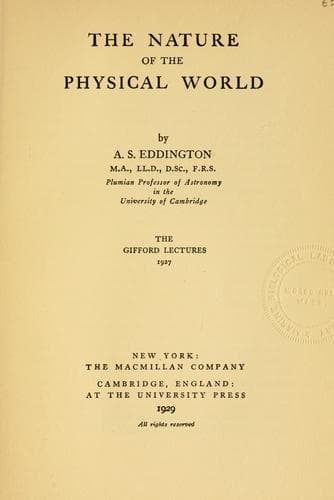
The nature of the physical worldEddington, Arthur Stanley, Sir
Philosophy
The nature of the physical world
Eddington, Arthur Stanley, Sir
Physics -- Philosophy; Science -- Philosophy
It is one thing to allow the mind to direct an atom between two
courses neither of which would be improbable for an inorganic atom;
it is another thing to allow it to direct a crowd of atoms into a
configuration which the secondary laws of physics would set aside as
“too improbable”. Here the improbability is that a large number of
entities each acting independently should conspire to produce the
result; it is like the improbability of the atoms finding themselves
by chance all in one half of a vessel. We must suppose that in the
physical part of the brain immediately affected by a mental decision
there is some kind of interdependence of behaviour of the atoms which
is not present in inorganic matter.
I do not wish to minimise the seriousness of admitting this difference
between living and dead matter. But I think that the difficulty has
been eased a little, if it has not been removed. To leave the atom
constituted as it was but to interfere with the probability of its
undetermined behaviour, does not seem quite so drastic an interference
with natural law as other modes of mental interference that have
been suggested. (Perhaps that is only because we do not understand
enough about these probabilities to realise the heinousness of our
suggestion.) Unless it belies its name, probability can be modified in
ways which ordinary physical entities would not admit of. There can be
no unique probability attached to any event or behaviour; we can only
speak of “probability in the light of certain given information”, and
[Pg 315]
the probability alters according to the extent of the information. It
is, I think, one of the most unsatisfactory features of the new quantum
theory in its present stage that it scarcely seems to recognise this
fact, and leaves us to guess at the basis of information to which its
probability theorems are supposed to refer.
Looking at it from another aspect—if the unity of a man’s
consciousness is not an illusion, there must be some corresponding
unity in the relations of the mind-stuff which is behind the pointer
readings. Applying our measures of relation structure, as in
chapter XI, we shall build matter and fields
of force obeying identically the principal field-laws; the atoms will
individually be in no way different from those which are without this
unity in the background. But it seems plausible that when we consider
their collective behaviour we shall have to take account of the broader
unifying trends in the mind-stuff, and not expect the statistical
results to agree with those appropriate to structures of haphazard
origin.
Public-domain text, read in full here on John Shaqi.
Reviews
Reviews
No reviews yet
Be the first to share your thoughts on this work.
Elsewhere in the archive
Join the Discussion
Join the discussion
Sign in to leave a comment or review.
Sign InorCreate an account