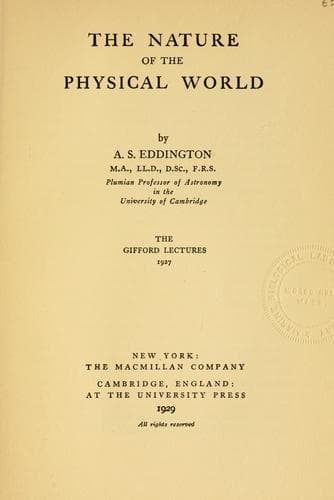
The nature of the physical worldEddington, Arthur Stanley, Sir
Philosophy
The nature of the physical world
Eddington, Arthur Stanley, Sir
Physics -- Philosophy; Science -- Philosophy
I think that even a materialist must reach a conclusion not unlike ours
if he fairly faces the problem. He will need in the physical world
something to stand for a symbolic unity of the atoms associated with
an individual consciousness, which does not exist for atoms not so
associated—a unity which naturally upsets physical predictions based
on the hypothesis of random disconnection. For he has not only to
translate into material configurations the multifarious thoughts and
images of the mind, but must surely not neglect to find some kind of
physical substitute for the Ego.
[47]
A few days after the course of lectures was completed,
Einstein wrote in his message on the Newton Centenary, “It is only
in the quantum theory that Newton’s differential method becomes
inadequate, and indeed strict causality fails us. But the last word
has not yet been said. May the spirit of Newton’s method give us the
power to restore unison between physical reality and the profoundest
characteristic of Newton’s teaching—strict causality.” (Nature,
1927, March 26, p. 467.)
[48]
It is fair to assume the trustworthiness of this
intuition in answering an argument which appeals to intuition; the
assumption would beg the question if we were urging the argument
independently.
[Pg 316]
Chapter XV
SCIENCE AND MYSTICISM
One day I happened to be occupied with the subject of “Generation of
Waves by Wind”. I took down the standard treatise on hydrodynamics, and
under that heading I read—
The equations (12) and (13) of the preceding Art. enable us to
examine a related question of some interest, viz. the generation and
maintenance of waves against viscosity, by suitable forces applied to
the surface.
If the external forces , be given multiples of
, where and are prescribed, the
equations in question determine and , and thence, by (9)
the value of . Thus we find
where has been written for as before....
And so on for two pages. At the end it is made clear that a wind of
less than half a mile an hour will leave the surface unruffled. At a
mile an hour the surface is covered with minute corrugations due to
capillary waves which decay immediately the disturbing cause ceases.
At two miles an hour the gravity waves appear. As the author modestly
concludes, “Our theoretical investigations give considerable insight
into the incipient stages of wave-formation”.
On another occasion the same subject of “Generation of Waves by Wind”
[Pg 317]
was in my mind; but this time another book was more appropriate, and I
read—
There are waters blown by changing winds to laughter
And lit by the rich skies, all day. And after,
Frost, with a gesture, stays the waves that dance
And wandering loveliness. He leaves a white
Unbroken glory, a gathered radiance,
A width, a shining peace, under the night.
Public-domain text, read in full here on John Shaqi.
Reviews
Reviews
No reviews yet
Be the first to share your thoughts on this work.
Elsewhere in the archive
Join the Discussion
Join the discussion
Sign in to leave a comment or review.
Sign InorCreate an account