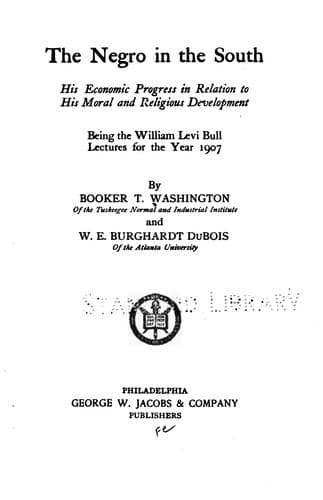
The Negro in the South: His Economic Progress in Relation to his Moral and Religious DevelopmentDu Bois, W. E. B. (William Edward Burghardt)
History
The Negro in the South: His Economic Progress in Relation to his Moral and Religious Development
Du Bois, W. E. B. (William Edward Burghardt)
African Americans -- Southern States
A few months ago I was in a mining camp composed largely of members of
my race who were, for the most part, ignorant and uncultivated, who
had had little opportunities in the way of education, but they had
been taught to mine coal. The operators of this mine complained that,
notwithstanding the unusually high wages being paid during that
season, these miners could not be induced to work more than three or
four days out of six. The difficulty was right here; these miners
were so ignorant that they had few wants, and these were simple and
crude. Their wants could be satisfied by working a few days out of
each week, and when they had satisfied their wants they could not
understand why it was necessary to work any longer, and we must all
acknowledge that there is a good deal of human nature in this point of
view.
In a case of this kind, what is needed is not only to have the
individual educated in industry but to have his hand so trained that
he will become ambitious; as one man put it not long ago, "He will
want more wants." We should get the man to the point where he will
want a house, where his wife will want carpet for the floor, pictures
for the walls, books, a newspaper and a substantial kind of furniture.
We should get the family to the point where it will want money to
educate its children, to support the minister and the church. Later,
we should get this family to the point where it will want to put
money in the bank and perhaps have the experience of placing a
mortgage on some property. When this stage of development has been
reached, there is no difficulty in getting individuals to work six
days during the week.
I have in mind now an old colored man who lived some four miles from
the Institution. I first noticed him a number of years ago as I took
my daily exercise after my day's work. I found him and his wife living
in a little broken-down cabin and resolved to try an experiment on
them to see if I could not get them to realize that that kind of life
proved of no benefit. When I began, their wants were for the bare
necessities of life only. I gradually began to talk to his wife and
urge her to see the importance of living a different kind of life.
Without the old man's knowing it, I took pains to tell her of how some
of their neighbors were living and about some of the things her
neighbors were owning. Some had two-room houses, glass windows, new
furniture, and little pieces of carpet, and had whitewashed their
houses. Finally she became quite interested.
Public-domain text, read in full here on John Shaqi.
Reviews
Reviews
No reviews yet
Be the first to share your thoughts on this work.
Join the Discussion
Join the discussion
Sign in to leave a comment or review.
Sign InorCreate an account