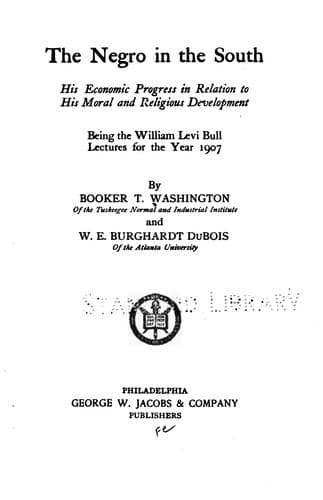
The Negro in the South: His Economic Progress in Relation to his Moral and Religious DevelopmentDu Bois, W. E. B. (William Edward Burghardt)
History
The Negro in the South: His Economic Progress in Relation to his Moral and Religious Development
Du Bois, W. E. B. (William Edward Burghardt)
African Americans -- Southern States
Many of these seemingly ignorant people, while not educated in the way
that we consider education, have in reality a very high form of
education--that which they have gotten out of contact with nature.
Only a few days ago I heard one of these old farmers, who could
neither read nor write, give a lesson before a Farmers' Institute that
I shall never forget. The old man got up on the platform and began
with this remark: "I'se had no chance to study science, but I'se been
making some science for myself," and then he held up before the
audience a stalk of cotton with only two bolls on it. He said he began
his scientific work with that stalk. Then he held up a second stalk
and showed how the following year he had improved the soil so that the
stalk contained four bolls, and then he held up a third stalk and
showed how he had improved the soil and method of cultivation until
the stalk contained six bolls, and so he went through the whole
process until he had demonstrated to his fellow farmers how he had
made a single stalk of cotton produce twelve or fourteen bolls. At the
close of the old man's address somebody in the audience asked what his
name was. He replied, "When I didn't own no home and was in debt,
they used to call me old Jim Hill, but now that I own a home and am
out of debt, they call me 'Mr. James Hill.'"
In the previous chapter I referred to the practical benefit that could
be achieved in foreign mission fields through economic and industrial
development. Now that industrial education is understood and
appreciated by the Negro in America, the question which has the most
practical value to you and to me is what effect has this kind of
development had upon the moral and religious life of the Negro right
here in America since the race became free.
By reason of the difficulty in getting reliable and comprehensive
statistics, it is not easy to answer this question with satisfaction,
but I believe that enough facts can be given to show that economic and
industrial development has wonderfully improved the moral and
religious life of the Negro race in America, and that, just in
proportion as any race progresses in this same direction, its moral
and religious life will be strengthened and made more practical.
Let me first emphasize the fact that in order for the moral and
religious life to be strengthened we must of necessity have industry,
but along with industry there must be intelligence and refinement.
Without these two elements combined, the moral and religious lives of
the people are not very much helped.
Public-domain text, read in full here on John Shaqi.
Reviews
Reviews
No reviews yet
Be the first to share your thoughts on this work.
Join the Discussion
Join the discussion
Sign in to leave a comment or review.
Sign InorCreate an account