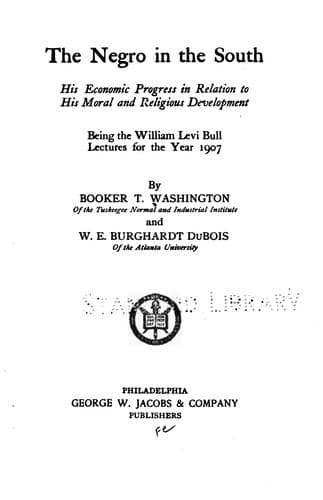
The Negro in the South: His Economic Progress in Relation to his Moral and Religious Development — John Shaqi
The Negro in the South: His Economic Progress in Relation to his Moral and Religious DevelopmentDu Bois, W. E. B. (William Edward Burghardt)
History
The Negro in the South: His Economic Progress in Relation to his Moral and Religious Development
Du Bois, W. E. B. (William Edward Burghardt)
African Americans -- Southern States
But as to the results of industrial training. Following the example of
the modern pedagogue, let me begin with that which I know most about,
the Tuskeegee Institute. This institution employs one of its officers
who spends a large part of his time in keeping in close contact with
our graduates and former students. He visits them in their homes and
in their places of employment and not only sees for himself what they
are doing, but gets the testimony of their neighbors and employers,
and I can state positively that not ten per cent. of the men and women
who have graduated from the Tuskeegee Institute or who have been there
long enough to understand the spirit and methods of that institution
can be found to-day in idleness in any part of the country. They are
at work because they have learned the dignity and beauty and
civilizing influence and, I might add, Christianizing power of labor;
they have learned the degradation and demoralizing influence of
idleness; they have learned to love labor for its own sake and are
miserable unless they are at work. I consider labor one of the
greatest boons which our Creator has conferred upon human beings.
Further, after making careful investigation, I am prepared to say that
there is not a single man or woman who holds a diploma from the
Tuskeegee Institute who can be found within the walls of any
penitentiary in the United States.
I have learned that not more than a score of the graduates of the
fifteen oldest and largest colleges and industrial schools in the
entire South have been sent to prison since these institutions were
established. Those who are guilty of crime for the most part are
individuals who are without education, without a trade, who own no
land, who are not taxpayers, who have no bank account, and who have
made no progress in industrial and economic development.
The following extracts from a letter written by a Southern white man
to the _Daily Advertiser_, of Montgomery, Alabama, contains most
valuable testimony. The letter refers to convicts in Alabama, most of
whom are colored:
"I was conversing not long ago with the warden of one of our
mining prisons, containing about 500 convicts. The warden is a
practical man, who has been in charge of prisoners for more than
fifteen years, and has no theories of any kind to support. I
remarked to him that I wanted some information as to the effect
of manual training in preventing criminality, and asked him to
state what per cent. of the prisoners under his charge had
received any manual training, besides acquaintance with the
crudest agricultural labor. He replied: 'Perhaps about one per
cent.' He added: 'No, much less than that. We have here at
present only one mechanic; that is, there is one man who claims
to be a house painter.'
"'Have you any shoemakers?'
"'Never had a shoemaker.'
"'Have you any tailors?'
"'Never had a tailor.'
"'Any printers?'
Public-domain text, read in full here on John Shaqi.
Reviews
Reviews
No reviews yet
Be the first to share your thoughts on this work.
Join the Discussion
Join the discussion
Sign in to leave a comment or review.
Sign InorCreate an account