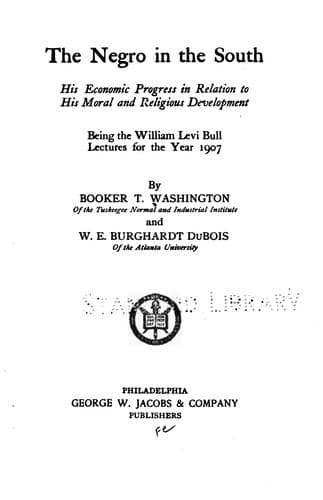
The Negro in the South: His Economic Progress in Relation to his Moral and Religious Development — John Shaqi
The Negro in the South: His Economic Progress in Relation to his Moral and Religious DevelopmentDu Bois, W. E. B. (William Edward Burghardt)
History
The Negro in the South: His Economic Progress in Relation to his Moral and Religious Development
Du Bois, W. E. B. (William Edward Burghardt)
African Americans -- Southern States
"'Never had a printer.'
"'Any carpenters?'
"'Never had a carpenter. There is not a man in this prison that
could saw to a straight line.'"
Now these facts seem to show that manual training is almost as good a
preventative of criminality as vaccination is of smallpox.
The records of the South show that ninety per cent. of the colored
people in prisons are without knowledge of trades, and sixty-one per
cent. are illiterate.
There are few higher authorities on the progress of the Negro than
Joel Chandler Harris, of the _Atlanta Constitution_, of "Uncle Remus"
fame. Mr. Harris had opportunity to know the Negro before the war, and
he has followed his progress closely in freedom. In a printed
statement made some time ago Mr. Harris says:
"The point I desire to make is that the overwhelming majority of
the Negroes in all parts of the South, especially in the
agricultural regions, are leading sober and industrious lives. A
temperate race is bound to be industrious, and the Negroes are
temperate when compared with the whites. Even in the towns the
majority of them are sober and industrious."
Dr. Frissell makes the same statement regarding Hampton Institute. Not
more than a score of the graduates have been sent to prison since
these institutions were established. The majority is among those who
are without training and who have made no progress in industrial and
economic development. The idle and criminal classes among them make a
great show in the police court records, but right here in Atlanta the
respectable and decent Negroes far outnumber those who are on the
lists of the police as old or new offenders. I am bound to conclude
from what I see all about me, and what I know of the race elsewhere,
that the Negro, notwithstanding the late start he has made in
civilization and enlightenment, is capable of making himself a useful
member in the communities in which he lives and moves, and that he is
become more and more desirous of conforming to all the laws that have
been enacted for the protection of society.
Some time ago I sent out letters to representative Southern men,
covering each ex-slave state, asking them to state, judging by their
observation in their own communities, what effect industrial education
has upon the morals and religion of the Negro. To these questions I
received 136 replies as follows:
Has education improved the morals of the black race?
Answers--Yes, 97; No, 20; Unanswered, 19.
Has it made his religion less emotional and more practical?
Answers--Yes, 101; No, 16; Unanswered, 19.
Is it, as a rule, the ignorant or the educated who commit crime?
Answers--Ignorant, 115; Educated, 3; Unanswered, 18.
Does crime grow less as education increases among the colored people?
Answers--Yes, 102; No, 19; Unanswered, 15.
Do not these figures speak for themselves?
Public-domain text, read in full here on John Shaqi.
Reviews
Reviews
No reviews yet
Be the first to share your thoughts on this work.
Join the Discussion
Join the discussion
Sign in to leave a comment or review.
Sign InorCreate an account