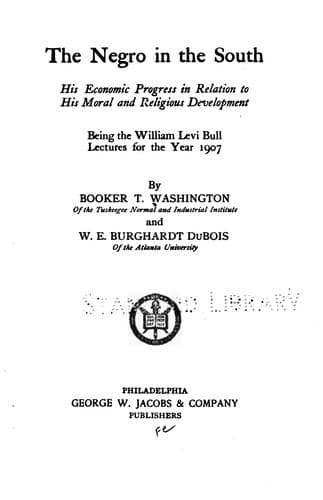
The Negro in the South: His Economic Progress in Relation to his Moral and Religious DevelopmentDu Bois, W. E. B. (William Edward Burghardt)
History
The Negro in the South: His Economic Progress in Relation to his Moral and Religious Development
Du Bois, W. E. B. (William Edward Burghardt)
African Americans -- Southern States
My subject naturally leads me to a discussion of the Negro as he was
in slavery. We must all acknowledge, whatever else resulted from
slavery that, first of all, it was the economic element involved that
brought the Negro to America, and it was largely this consideration
that held the race in slavery for a period of about 245 years. But,
in this discussion, I am not to consider the economic value of the
Negro as a slave, as such, but only the influence of his industrial
training while in slavery in the development of his moral and
religious life.
In my opinion, it requires no little effort on the part of a man who
was once himself a slave to be able to admit this. If any Negro who
was a part of the institution of slavery itself can so far rid himself
of the prejudices of the same, it seems to me other people, living in
whatever section, should be able to do so.
I have been a slave once in my life--a slave in body. But I long since
resolved that no inducement and no influence would ever make me a
slave in soul, in my love for humanity, and in my search for truth.
At the same time slaves were being brought to the shores of Virginia
from their native land, Africa, the woods of Virginia were swarming
with thousands of another dark-skinned race. The question naturally
arises: Why did the importers of Negro slaves go to the trouble and
expense of going thousands of miles for a dark-skinned people to hew
wood and draw water for the whites, when they had right among them a
people of another race who could have answered the purpose? The answer
is that the Indian was tried and found wanting in the commercial
qualities which the Negro seemed to possess. The Indian, as a race,
would not submit to slavery and in those instances where he was tried,
as a slave, his labor was not profitable and he was found unable to
stand the physical strain of slavery. As a slave, the Indian died in
large numbers. This was true in San Domingo and in other parts of the
American continent.
The two races, the Indian and the Negro, have been often compared to
the disadvantage of the Negro. It is often said of the Negro that he
is an imitative race. That, in a large degree, is true. That element
has its disadvantages and it also has its advantages. Very often the
Negro imitates the worst element in the white man; on the other hand I
believe that the masses of our people imitate the best they find in
the white man.
Public-domain text, read in full here on John Shaqi.
Reviews
Reviews
No reviews yet
Be the first to share your thoughts on this work.
Join the Discussion
Join the discussion
Sign in to leave a comment or review.
Sign InorCreate an account