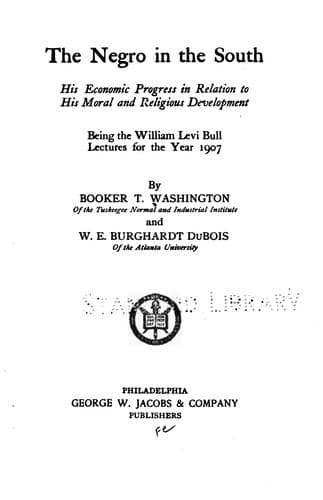
The Negro in the South: His Economic Progress in Relation to his Moral and Religious DevelopmentDu Bois, W. E. B. (William Edward Burghardt)
History
The Negro in the South: His Economic Progress in Relation to his Moral and Religious Development
Du Bois, W. E. B. (William Edward Burghardt)
African Americans -- Southern States
I have said more than once that one of the unfortunate conditions of
the Negro in the North is that,--because of the large proportion of
our people who are in menial service, their duties bring them in
contact with the worst. They, for example, are waiters in clubs and in
various organizations, and being engaged in that capacity makes it
necessary for them to touch the white man at his weakest point. In the
city of Philadelphia, there are hundreds, I do not suppose I should
exaggerate if I were to say thousands, who are serving the white man
as a waiter in some club or similar organization. When that white man
was at work in his factory, in his counting-room, in his bank, he was
far removed from him. When he was at his best the Negro did not come
into touch with him. In the evening when he lays aside the working
dress, takes matters easy, and gets his cigar and perhaps champagne,
the Negro comes into contact with him, not to an advantage, but at his
weakest point rather than at his strongest.
In the South, as in most parts of America, during slavery and after,
the Negro has gotten something from the white man that has made him
more valuable as a citizen. In most cases he imitates the best rather
than the worst. For example, you never see a Negro braiding his hair
in the same way as a Chinaman braids his, but he cuts his like the
white man. The Negro is seeking out the highest and best as to
quality.
It has been more than once stated that the Indian proved himself the
superior race in not submitting to slavery. We shall see about this.
In this respect it may be that the Indian secured a temporary
advantage in so far as race feeling or prejudice is concerned; I mean
by this that he escaped the badge of servitude which has fastened
itself upon the Negro,--not only upon the Negro in America, but upon
that race wherever found, for the known commercial value of the Negro
has made him a subject of traffic in other portions of the globe
during many centuries.
The Indian refused to submit to bondage and to learn the white man's
ways. The result is that the greater portion of the American Indians
have disappeared, the greater portion of those who remain are not
civilized. The Negro, wiser and more enduring than the Indian,
patiently endured slavery; and contact with the white man has given
him a civilization vastly superior to that of the Indian.
Public-domain text, read in full here on John Shaqi.
Reviews
Reviews
No reviews yet
Be the first to share your thoughts on this work.
Join the Discussion
Join the discussion
Sign in to leave a comment or review.
Sign InorCreate an account