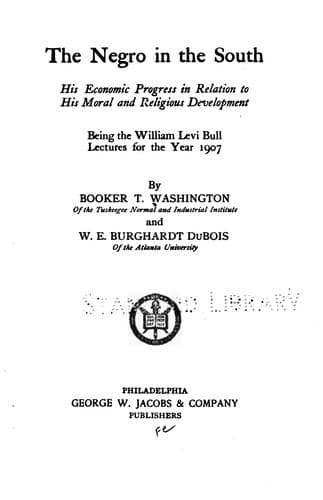
The Negro in the South: His Economic Progress in Relation to his Moral and Religious DevelopmentDu Bois, W. E. B. (William Edward Burghardt)
History
The Negro in the South: His Economic Progress in Relation to his Moral and Religious Development
Du Bois, W. E. B. (William Edward Burghardt)
African Americans -- Southern States
It is becoming distinctly obvious to Negroes that to-day, in modern
economic organization, the one thing that is giving the workman a
chance is intelligence and political power, and that it is utterly
impossible for a moment to suppose that the Negro in the South is
going to hold his own in the new competition with immigrants if, on
the one hand, the immigrant has access to the best schools of the
community and has equal political power with other men to defend his
rights and to assert his wishes, while, on the other hand, his black
competitor is not only weighed down by past degradation, but has few
or no schools and is disfranchised.
The question then as to what will happen in the South when immigration
comes, is a very simple question. If the Negro is kept disfranchised
and ignorant and if the new foreign immigrants are allowed access to
the schools and given votes as they undoubtedly will be, then there
can ensue only accentuated race hatred, the spread of poverty and
disease among Negroes, the increase of crime, and the gradual murder
of the eight millions of black men who live in the South except in so
far as they escape North and bring their problems there as thousands
will.
If on the contrary, with the coming of the immigrants to the South,
there is given to the Negro equal educational opportunity and the
chance to cast his vote like a man and be counted as a man in the
councils of the county, city, state and nation, then there will ensue
that competition between men in the industrial world which, if it is
not altogether just, is at least better than slavery and serfdom.
There of course could be strong argument that the nation owes the
Negro something better than harsh industrial competition just after
slavery, but the Negro does not ask the payment of debts that are
dead. He is perfectly willing to come into competition with immigrants
from any part of the world, to welcome them as human beings and as
fellows in the struggle for life, to struggle with them and for them
and for a greater South and a better nation. But the black man
certainly has a right to ask, when he starts into this race, that he
be allowed to start with hands untied and brain unclouded (see Note
17).
Public-domain text, read in full here on John Shaqi.
Reviews
Reviews
No reviews yet
Be the first to share your thoughts on this work.
Join the Discussion
Join the discussion
Sign in to leave a comment or review.
Sign InorCreate an account