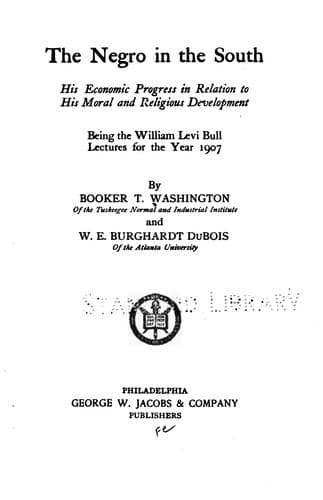
The Negro in the South: His Economic Progress in Relation to his Moral and Religious DevelopmentDu Bois, W. E. B. (William Edward Burghardt)
History
The Negro in the South: His Economic Progress in Relation to his Moral and Religious Development
Du Bois, W. E. B. (William Edward Burghardt)
African Americans -- Southern States
It is this paradox that brings us to-day in the South to a fourth
solution of the problem: Immigration. The voice that calls foreign
immigrants southward to-day is not single but double. First, the
exploiter of common labor wishes to exploit this new labor just as
formerly he exploited Negro labor. On the other hand the far-sighted
ones know that the present freedom of labor exploitation must
pass--that some time or other the industrial system of the South must
be made to conform more and more to the growing sense of industrial
justice in the North and in the civilized world. Consequently the
second object of the immigration philosopher is to make sure that,
when the rights of the laborer come to be recognized in the South,
that laborer will be white, and just so far as possible the black
laborer will still be forced down below the white laborer until he
becomes thoroughly demoralized or extinct.
The query is therefore: If immigration turns toward the South as it
undoubtedly will in time, what will become of the Negro? The view of
the white world is usually that there are two possibilities. First,
that the immigrants will crush the Negro utterly; or secondly, that by
competition there will come a sifting which will lead to the survival
of the best in both groups of laborers.
Let us consider these possibilities. First it is certain that so far
as the Negroes are land holders, and so far as they belong to a
self-employing, self-supplying group economy, no possible competition
from without can disturb them. I have shown already how rapidly this
system is growing. Further than that, there is a large group of
Negroes who have already gained an assured place in the national
economy as artisans, servants, and laborers. The worst of these may be
supplanted, but the best could not be unless there came a sudden
unprecedented and improbable influx of skilled foreign labor. A slow
infiltration of foreigners cannot displace the better class of Negro
workers; simply because the growing labor demand of the South cannot
spare them. If then it is to be merely a matter of ability to work,
the result of immigration will on the whole be beneficial and will
differentiate the good Negro workman from the careless and
indifferent.
But one element remains to be considered, and this is political power.
If the black workman is to remain disfranchised while the white native
and immigrant not only has the economic defense of the ballot, but the
power to use it so as to hem in the Negro competitor, cow and
humiliate him and force him to a lower plane, then the Negro will
suffer from immigration.
Public-domain text, read in full here on John Shaqi.
Reviews
Reviews
No reviews yet
Be the first to share your thoughts on this work.
Join the Discussion
Join the discussion
Sign in to leave a comment or review.
Sign InorCreate an account