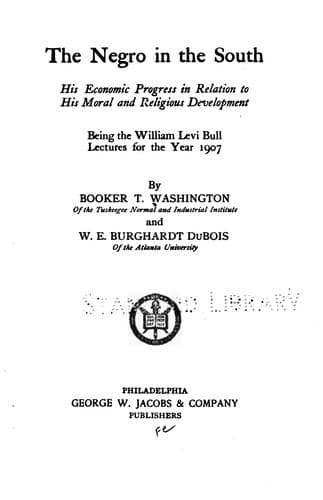
The Negro in the South: His Economic Progress in Relation to his Moral and Religious Development — John Shaqi
The Negro in the South: His Economic Progress in Relation to his Moral and Religious DevelopmentDu Bois, W. E. B. (William Edward Burghardt)
History
The Negro in the South: His Economic Progress in Relation to his Moral and Religious Development
Du Bois, W. E. B. (William Edward Burghardt)
African Americans -- Southern States
It is very difficult of course for one who has not seen the practical
difficulties that surround a people at any particular time in their
battle with the hard facts of this world, to interpret with sympathy
their ideals of life; and this is especially difficult when the
economic life of a nation has been expressed by such a discredited
word as slavery. If, then, we are to study the history of religion in
the South, we must first of all divest ourselves of prejudice, pro and
con; we must try to put ourselves in the place of those who are
seeking to read the riddle of life and grant to them about the same
general charity and the same general desire to do right that we find
in the average human being. On the other hand, we must not, in
striving to be charitable, be false to truth and right. Slavery in the
United States was an economic mistake and a moral crime. This we
cannot forget. Yet it had its excuses and mitigations. These we must
remember.
When in the seventeenth century there grew up in the New World a
system of human slavery, it was not by any means a new thing. There
were slaves and slavery in Europe, not, to be sure, to a great extent,
but none the less real. The Christian religion, however, had come to
regard it as wrong and unjust that those who partook of the privileges
and hopes and aspirations of that religion should oppress each other
to the extent of actual enslavement. The idea of human brotherhood in
the seventeenth century was of a brotherhood of co-religionists. When
it came to the dealing of Christian with heathen, however, the
century saw nothing wrong in slavery; rather, theoretically, they saw
a chance for a great act of humanity and religion. The slaves were to
be brought from heathenism to Christianity, and through slavery the
benighted Indian and African were to find their passport into the
kingdom of God. This theory of human slavery was held by Spaniards,
French, and English. It was New England in the early days that put the
echo of it in her codes (see Note 18) and recognition of it can be
seen in most of the colonies.
But no sooner had people adopted this theory than there came the
insistent and perplexing question as to what the status of the heathen
slave was to be after he was Christianized and baptized; and even more
pressing, what was to be the status of his children?
It took a great deal of bitter heart searching for the conscientious
early slave-holders to settle this question. The obvious state of
things was that the new convert awoke immediately to the freedom of
Christ and became a freeman. But while this was the theoretical,
religious answer, and indeed the answer which was given in several
instances, the practice soon came into direct and perplexing conflict
with the grim facts of economic life.
Public-domain text, read in full here on John Shaqi.
Reviews
Reviews
No reviews yet
Be the first to share your thoughts on this work.
Join the Discussion
Join the discussion
Sign in to leave a comment or review.
Sign InorCreate an account