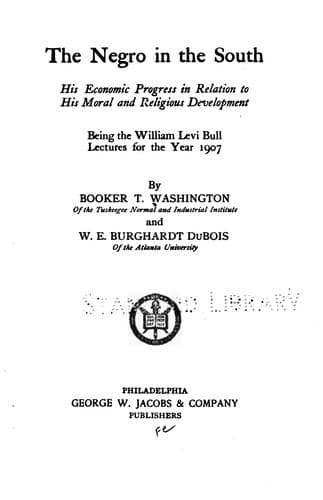
The Negro in the South: His Economic Progress in Relation to his Moral and Religious DevelopmentDu Bois, W. E. B. (William Edward Burghardt)
History
The Negro in the South: His Economic Progress in Relation to his Moral and Religious Development
Du Bois, W. E. B. (William Edward Burghardt)
African Americans -- Southern States
Here was a man who had invested his money and his labor in slaves; he
had done it with dependence on the institution of property. Could he
be deprived of his property simply because his slaves were baptized
afterward into a Christian church? Very soon such economic reasoning
swept away the theological dogma and it was expressly declared in
colony after colony that baptism did not free the slaves (see Note
19). This, of course, put an end to the old doctrine of the heathen
slave and it was necessary for the church to arrange for itself a new
theory by which it could ameliorate, if not excuse, the position of
the slave. The next question was naturally that of the children of
slaves born in Christianity and the church for a time hedged
unworthily on the subject by consigning to perpetual slavery the
children of heathen but not those born of Christian parents; this was
satisfactory for the first generation but it fell short of the logic
of slavery later, and a new adjustment was demanded.
Here again this was not found difficult. In Virginia there had been
built up the beginnings of a feudal aristocracy. Men saw nothing wrong
or unthinkable in the situation as it began to develop, but rather
something familiar. At the head of the feudal manor was the lord, or
master, beneath him the under-lord or overseers and then the artisans,
retainers, the free working men and lastly the serfs, slaves or
servants as they were called. The servant was not free and yet he was
not theoretically exactly a slave, and the laws of Virginia were
rather careful to speak very little of slaves.
Serfdom in America as in Europe was to be a matter of status or
position and not of race or blood, and the law of the South in the
seventeenth and early eighteenth centuries made little or no
distinction between black and white bondservants save in the time of
their service. The idea, felt rather than expressed, was that here in
America we were to have a new feudalism suited to the new country. At
the top was the governor of the colony representing the majesty of the
English king, at the bottom the serfs or slaves, some white, most of
them black.
Slavery therefore was gradually transformed in the seventeenth and
eighteenth centuries into a social status out of which a man, even a
black man, could escape and did escape; and, no matter what his color
was, when he became free, he became free in the same sense that other
people were. Thus it was that there were free black voters in the
southern colonies (Virginia and the Carolinas) in the early days
concerning whose right to vote there was less question than there is
concerning my right to vote now in Georgia (see Note 20).
Public-domain text, read in full here on John Shaqi.
Reviews
Reviews
No reviews yet
Be the first to share your thoughts on this work.
Join the Discussion
Join the discussion
Sign in to leave a comment or review.
Sign InorCreate an account