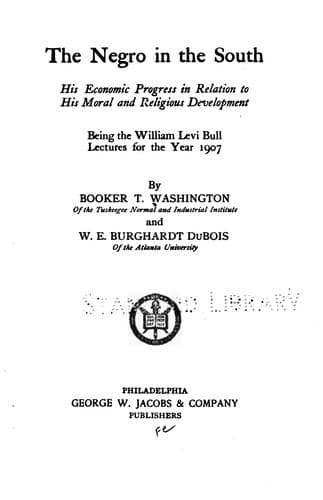
The Negro in the South: His Economic Progress in Relation to his Moral and Religious Development — John Shaqi
The Negro in the South: His Economic Progress in Relation to his Moral and Religious DevelopmentDu Bois, W. E. B. (William Edward Burghardt)
History
The Negro in the South: His Economic Progress in Relation to his Moral and Religious Development
Du Bois, W. E. B. (William Edward Burghardt)
African Americans -- Southern States
John Randolph of Roanoke once visited a lady and "found her surrounded
with her seamstresses, making up a quantity of clothing. 'What work
have you in hand?' 'O sir, I am preparing this clothing to send to the
poor Greeks.' On taking leave at the steps of her mansion, he saw
some of her servants in need of the very clothing which their
tender-hearted mistress was sending abroad. He exclaimed, 'Madam,
madam, the Greeks are at your door!'"
One natural solution of this difficulty was to train teachers and
preachers for the slaves from among their own number. The old Voodoo
priests were passing away and already here and there new spiritual
leaders of the Negroes began to arise. Accounts of several of these,
taken from "The Negro Church," will be given.
Among the earliest was Harry Hosier who traveled with the Methodist
Bishop Asbury and often filled appointments for him. George Leile and
Andrew Bryan were preachers whose life history is of intense interest.
"George Leile or Lisle, sometimes called George Sharp, was born in
Virginia about 1750. His master (Mr. Sharp) some time before the
American war removed and settled in Burke County, Georgia. Mr. Sharp
was a Baptist and a deacon in a Baptist church, of which Rev. Matthew
Moore was pastor. George was converted and baptized under Mr. Moore's
ministry. The church gave him liberty to preach.
"About nine months after George Leile left Georgia, Andrew, surnamed
Bryan, a man of good sense, great zeal, and some natural elocution,
began to exhort his black brethren and friends. He and his followers
were reprimanded and forbidden to engage further in religious
exercises. He would, however, pray, sing, and encourage his fellow
worshipers to seek the Lord.
"Their persecution was carried to an inhuman extent. Their evening
assemblies were broken up and those found present were punished with
stripes. Andrew Bryan and Sampson, his brother, converted about a year
after him, were twice imprisoned, and they with about fifty others
were whipped. When publicly whipped, and bleeding under his wounds,
Andrew declared that he not only rejoiced to be whipped, but would
gladly suffer death for the cause of Jesus Christ, and that while he
had life and opportunity he would continue to preach Christ. He was
faithful to his vow and, by patient continuance in well-doing, he put
to silence and shamed his adversaries, and influential advocates and
patrons were raised up for him. Liberty was given Andrew by the civil
authority to continue his religious meetings under certain
regulations. His master gave him the use of his barn at Brampton,
three miles from Savannah, where he preached for two years with little
interruption."
Public-domain text, read in full here on John Shaqi.
Reviews
Reviews
No reviews yet
Be the first to share your thoughts on this work.
Join the Discussion
Join the discussion
Sign in to leave a comment or review.
Sign InorCreate an account