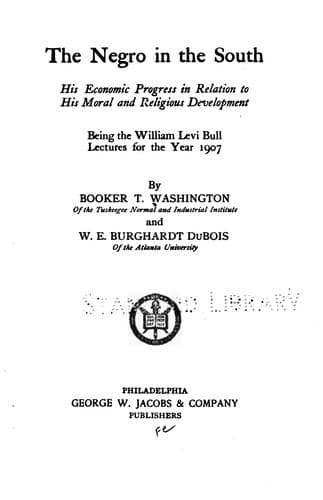
The Negro in the South: His Economic Progress in Relation to his Moral and Religious DevelopmentDu Bois, W. E. B. (William Edward Burghardt)
History
The Negro in the South: His Economic Progress in Relation to his Moral and Religious Development
Du Bois, W. E. B. (William Edward Burghardt)
African Americans -- Southern States
"The Negroes are a distinct class in the community, and keep
themselves very much to themselves. They are one thing before the
whites and another before their own color. Deception before the former
is characteristic of them, whether bond or free, throughout the whole
United States. It is habit, a long established custom, which descends
from generation to generation. There is an upper and an under current.
Some are contented with the appearance on the surface; others dive
beneath. Hence the diversity of impressions and representations of the
moral and religious condition of the Negroes. Hence the disposition of
some to deny the darker pictures of their more searching and knowing
friends."
He then enumerates the vice of the slaves: "The divine institution of
marriage depends for its perpetuity, sacredness, and value, largely
upon the protection given it by the law of the land. Negro marriages
are neither recognized nor protected by law. The Negroes receive no
instruction on the nature, sacredness, and perpetuity of the
institution; at any rate they are far from being duly impressed with
these things. They are not required to be married in any particular
form, nor by any particular persons."
He continues: "Hence, as may well be imagined, the marriage relation
loses much of the sacredness and perpetuity of its character. It is a
contract of convenience, profit, or pleasure, that may be entered into
and dissolved at the will of the parties, and that without heinous
sin, or the injury of the property or interests of any one. That which
they possess in common is speedily divided, and the support of the
wife and children falls not upon the husband, but upon the master.
Protracted sickness, want of industrial habits, of congeniality of
disposition, or disparity of age, are sufficient grounds for a
separation."
Under such circumstances, "polygamy is practiced both secretly and
openly." Un-cleanness, infanticide, theft, lying, quarreling, and
fighting are noted, and the words of Charles Cotesworth Pinckney in
1829 are recalled: "There needs no stronger illustration of the
doctrine of human depravity than the state of morals on plantations in
general. Besides the mischievous tendency of bad example in parents
and elders, the little Negro is often taught by these natural
instructors that he may commit any vice that he can conceal from his
superiors, and thus falsehood and deception are among the earliest
lessons they imbibe. Their advance in years is but a progression to
the higher grades of iniquity. The violation of the Seventh
Commandment is viewed in a more venial light than in fashionable
European circles. Their depredations of rice have been estimated to
amount to twenty-five per cent. of the gross average of crops."
Public-domain text, read in full here on John Shaqi.
Reviews
Reviews
No reviews yet
Be the first to share your thoughts on this work.
Join the Discussion
Join the discussion
Sign in to leave a comment or review.
Sign InorCreate an account