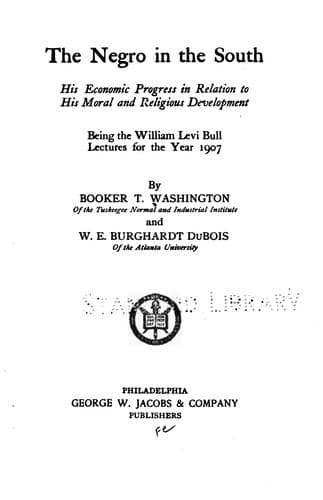
The Negro in the South: His Economic Progress in Relation to his Moral and Religious DevelopmentDu Bois, W. E. B. (William Edward Burghardt)
History
The Negro in the South: His Economic Progress in Relation to his Moral and Religious Development
Du Bois, W. E. B. (William Edward Burghardt)
African Americans -- Southern States
For a long time he taught school and had the best whites as pupils--a
United States senator, the sons of a chief justice of North Carolina,
a governor of the state and many others. Some of his pupils boarded in
the family, and his school was regarded as the best in the State. "All
accounts agree that John Chavis was a gentleman," and he was received
socially among the best whites and asked to table. In 1830 he was
stopped from preaching by the law. Afterward he taught a school for
free Negroes in Raleigh.
Henry Evans was a full-blooded Virginia free Negro, and was the
pioneer of Methodism in Fayetteville, N.C. He found the Negroes there,
about 1800, without any religious instruction. He began preaching and
the town council ordered him away; he continued and whites came to
hear him. Finally the white auditors outnumbered the blacks and sheds
were erected for Negroes at the side of the church. The gathering
became a regular Methodist Church, with a white and Negro membership,
but Evans continued to preach. He exhibited "rare self-control before
the most wretched of castes! Henry Evans did much good, but he would
have done more good had his spirit been untrammeled by this sense of
inferiority."
His dying words uttered as he stood, aged and bent beside his pulpit,
are of singular pathos: "I have come to say my last word to you. It
is this: None but Christ. Three times have I had my life in jeopardy
for preaching the gospel to you. Three times I have broken ice on the
edge of the water and swam across the Cape Fear to preach the gospel
to you; and, if in my last hour I could trust to that, or anything but
Christ crucified, for my salvation, all should be lost and my soul
perish forever."
Early in the nineteenth century Ralph Freeman was a slave in Anson
County, N.C. He was a full-blooded Negro, and was ordained and became
an able Baptist preacher. He baptized and administered communion, and
was greatly respected. When the Baptists split on the question of
missions he sided with the anti-mission side. Finally the law forbade
him to preach.
Lunsford Lane was a Negro who bought his freedom in Raleigh, N.C., by
the manufacture of smoking tobacco. He later became a minister of the
gospel, and had the confidence of many of the best people.
The story of Jack of Virginia is best told in the words of a Southern
writer:
"Probably the most interesting case in the whole South is that of an
African preacher of Nottoway County, popularly known as 'Uncle Jack,'
whose services to white and black were so valuable that a
distinguished minister of the Southern Presbyterian Church felt called
upon to memorialize his work in a biography.
Public-domain text, read in full here on John Shaqi.
Reviews
Reviews
No reviews yet
Be the first to share your thoughts on this work.
Join the Discussion
Join the discussion
Sign in to leave a comment or review.
Sign InorCreate an account