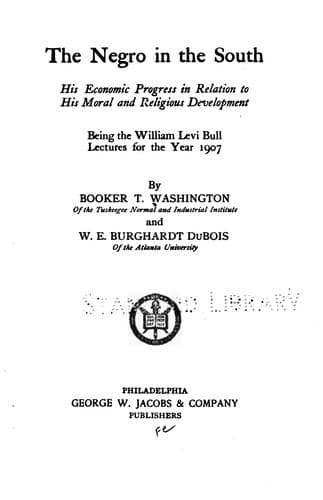
The Negro in the South: His Economic Progress in Relation to his Moral and Religious DevelopmentDu Bois, W. E. B. (William Edward Burghardt)
History
The Negro in the South: His Economic Progress in Relation to his Moral and Religious Development
Du Bois, W. E. B. (William Edward Burghardt)
African Americans -- Southern States
"Kidnapped from his idolatrous parents in Africa, he was brought over
in one of the last cargoes of slaves admitted to Virginia and sold to
a remote and obscure planter in Nottoway County, a region at that time
in the backwoods and destitute particularly as to religious life and
instruction. He was converted under the occasional preaching of Rev.
Dr. John Blair Smith, president of Hampden-Sidney College, and of Dr.
William Hill and Dr. Archibald Alexander of Princeton, then young
theologues, and by hearing the Scriptures read.
"Taught by his master's children to read, he became so full of the
spirit and knowledge of the Bible that he was recognized among the
whites as a powerful expounder of Christian doctrine, was licensed to
preach by the Baptist Church, and preached from plantation to
plantation within a radius of thirty miles, as he was invited by
overseers or masters. His freedom was purchased by a subscription of
whites, and he was given a home and tract of land for his support. He
organized a large and orderly Negro church, and exercised such a
wonderful controlling influence over the private morals of his flock
that masters, instead of punishing their slaves, often referred them
to the discipline of their pastor, which they dreaded far more.
"He stopped a heresy among the Negroes of Southern Virginia, defeating
in open argument a famous fanatical Negro preacher named Campbell, who
advocated noise and 'the spirit' against the Bible, and winning over
Campbell's adherents in a body. For over forty years, and until he was
nearly a hundred years of age, he labored successfully in public and
private among black and whites, voluntarily giving up his preaching in
obedience to the law of 1832, the result of 'Old Nat's war.'
"The most refined and aristocratic people paid tribute to him, and he
was instrumental in the conversion of many whites. Says his
biographer, Rev. Dr. William S. White: 'He was invited into their
houses, sat with their families, took part in their social worship,
sometimes leading the prayer at the family altar. Many of the most
intelligent people attended upon his ministry and listened to his
sermons with great delight. Indeed, previous to the year 1825, he was
considered by the best judges to be the best preacher in that county.
His opinions were respected, his advice followed, and yet he never
betrayed the least symptoms of arrogance or self-conceit.
"'His dwelling was a rude log cabin, his apparel of the plainest and
coarsest materials.' This was because he wanted to be fully identified
with his class. He refused gifts of better clothing, saying 'These
clothes are a great deal better than are generally worn by people of
my color, and besides if I wear finer ones I find I shall be obliged
to think about them even at meeting.'"
Public-domain text, read in full here on John Shaqi.
Reviews
Reviews
No reviews yet
Be the first to share your thoughts on this work.
Join the Discussion
Join the discussion
Sign in to leave a comment or review.
Sign InorCreate an account