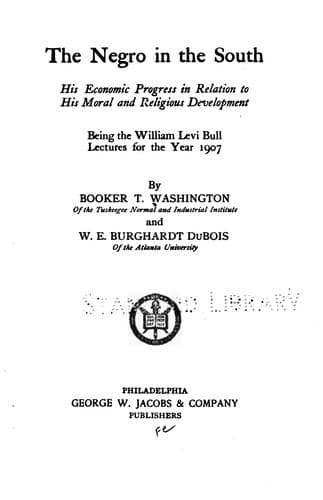
The Negro in the South: His Economic Progress in Relation to his Moral and Religious DevelopmentDu Bois, W. E. B. (William Edward Burghardt)
History
The Negro in the South: His Economic Progress in Relation to his Moral and Religious Development
Du Bois, W. E. B. (William Edward Burghardt)
African Americans -- Southern States
Cf. Baines, "History of the Cotton Manufactures," pp. 116-23;
"Encyclopædia Britannica," 9th ed., article "Cotton."
NOTE 2
In 1832, Alabama declared that "any person or persons who shall
attempt to teach any free person of color or slave to spell, read, or
write, shall, upon conviction thereof by indictment, be fined in a
sum not less than $250, nor more than $500."
Georgia, in 1770, fined any person who taught a slave to read or write
twenty pounds. In 1829 the State enacted:
"If any slave, Negro or free person of color, or any white person,
shall teach any other slave, Negro or free person of color to read or
write, either written or printed characters, the same free person of
color or slave shall be punished by fine and whipping, or fine or
whipping, at the discretion of the court; and if a white person so
offend, he, she or they shall be punished with a fine not exceeding
$500 and imprisonment in the common jail at the discretion of the
court."
In 1833 this law was put into the penal code, with additional
penalties for using slaves in printing offices to set type. These laws
were violated sometimes by individual masters, and clandestine schools
were opened for Negroes in some of the cities before the war. In 1850
and thereafter there was some agitation to repeal these laws and a
bill to that effect failed in the Senate of Georgia by two or three
votes.
Louisiana, in 1830, declared that "All persons who shall teach or
permit or cause to be taught any slave to read or write shall be
imprisoned not less than one month nor more than twelve months."
Missouri, in 1847, passed an act saying that "No person shall keep or
teach any school for the instruction of Negroes or mulattoes in
reading or writing in this state."
North Carolina had schools supported by free Negroes up until 1835,
when they were abolished by law.
South Carolina, in 1740, declared: "Whereas, the having of slaves
taught to write or suffering them to be employed in writing may be
attended with inconveniences, be it enacted, that all and every person
and persons whatsoever who shall hereafter teach or cause any slave
or slaves to be taught, or shall use or employ any slave as a scribe
in any manner of writing whatever, hereafter taught to write, every
such person or persons shall for every such offense forfeit the sum of
£100 current money."
In 1800 and 1833 the teaching of free Negroes was restricted: "And if
any free person of color or slave shall keep any school or other
places of instruction for teaching any slave or free person of color
to read or write, such free person of color or slave shall be liable
to the same fine, imprisonment and corporal punishment as by this act
are imposed and inflicted on free persons of color and slaves for
teaching slaves to write." Other sections prohibited white persons
from teaching slaves. Apparently whites might teach free Negroes to
some extent.
Public-domain text, read in full here on John Shaqi.
Reviews
Reviews
No reviews yet
Be the first to share your thoughts on this work.
Elsewhere in the archive
Join the Discussion
Join the discussion
Sign in to leave a comment or review.
Sign InorCreate an account