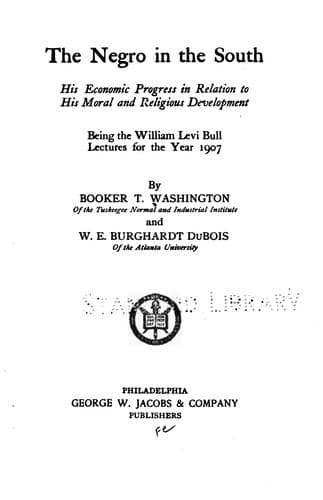
The Negro in the South: His Economic Progress in Relation to his Moral and Religious DevelopmentDu Bois, W. E. B. (William Edward Burghardt)
History
The Negro in the South: His Economic Progress in Relation to his Moral and Religious Development
Du Bois, W. E. B. (William Edward Burghardt)
African Americans -- Southern States
Virginia, in 1819, forbade "all meetings or assemblages of slaves or
free Negroes or mulattoes mixing and associating with such slaves,
... at any school or schools for teaching them reading and writing,
either in the day or night." Nevertheless free Negroes kept schools
for themselves until the Nat Turner Insurrection, when it was enacted,
1831, that "all meetings of free Negroes or mulattoes at any
school-house, church, meeting-house or other place, for teaching them
reading and writing, either in the day or night, under whatsoever
pretext, shall be deemed and considered an unlawful assembly." This
law was carefully enforced.
In the Northern States few actual prohibitory laws were enacted, but
in Connecticut, New York, Pennsylvania, Ohio and elsewhere, mob
violence frequently arose against Negro schools, and in Connecticut
the teaching of Negroes was restricted as follows in 1833: "No person
shall set up or establish in this state any school, academy or other
literary institution for the instruction or education of colored
persons who are not inhabitants of this State, or harbor or board,
for the purpose of attending or being taught or instructed in any such
school, academy or literary institution any colored person who is not
an inhabitant of any town in this State, without the consent, in
writing, first obtained, of a majority of the civil authority, and
also of the select-men of the town in which each school, academy or
literary institution is situated." This was especially directed
against the famous Prudence Crandall school, and was repeated in 1838.
Ohio decreed, in 1829, that "the attendance of black or mulatto
persons be specifically prohibited, but all taxes assessed upon the
property of colored persons for school purposes should be appropriated
to their instruction and no other purpose." This prohibition was
enforced, but the second clause was a dead letter for twenty years.
Cf. Atlanta University Publications, No. 6.
NOTE 3
Cf. Cairnes' "Slave Power."
NOTE 4
Public-domain text, read in full here on John Shaqi.
Reviews
Reviews
No reviews yet
Be the first to share your thoughts on this work.
Elsewhere in the archive
Join the Discussion
Join the discussion
Sign in to leave a comment or review.
Sign InorCreate an account