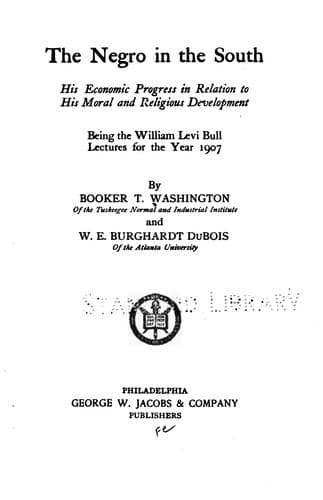
The Negro in the South: His Economic Progress in Relation to his Moral and Religious DevelopmentDu Bois, W. E. B. (William Edward Burghardt)
History
The Negro in the South: His Economic Progress in Relation to his Moral and Religious Development
Du Bois, W. E. B. (William Edward Burghardt)
African Americans -- Southern States
Stephen A. Douglas said "that there was not the shadow of doubt that
the slave-trade had been carried on quite extensively for a long time
back, and that there had been more slaves imported into the Southern
States, during the last year, than had ever been imported before in
any one year, even when the slave-trade was legal. It was his
confident belief, that over fifteen thousand slaves had been brought
into this country during the past year (1859). He had seen, with his
own eyes, three hundred of those recently-imported, miserable beings,
in a slave-pen in Vicksburg, Miss., and also large numbers at Memphis,
Tenn." It was currently reported that depots for these slaves existed
in over twenty large cities and towns in the South, and an interested
person boasted to a senator, about 1860, that "twelve vessels would
discharge their living freight upon our shores within ninety days from
the 1st of June last," and that between sixty and seventy cargoes had
been successfully introduced in the last eighteen months. (Cf. DuBois:
"Slave Trade," ch. xi.)
NOTE 5
Cf. Olmsted's "Journeys" and Helper's "Impending Crisis."
NOTE 6
Has not the time come for characterizing war plainly and ceasing to
envelope it in a haze of sentimental lies? We have near worshiped the
Civil War for a generation, when in truth it was a disgrace to
civilization and we know it.
NOTE 7
Cf. Blaine: "Twenty Years in Congress"; "American Political Science
Review," Vol. 1, pp. 44-61; _e.g._, "South Carolina, besides thus
minutely regulating the labor of Negroes under contract, prohibited
them from practicing the 'art, trade or business of an artisan,
mechanic, or shopkeeper,' or any other trade or business on their own
account without paying an annual license fee to the district judge.
And no Negro could obtain a license who had not served a term of
'apprenticeship' at the trade. Tennessee also required licenses; and
Mississippi required Negroes to have written evidence of their home
and employment. Mississippi also prohibited the renting or leasing of
any land to Negroes, except in incorporated towns and cities."
Louisiana had perhaps the most outrageous provisions.
NOTE 8
Public-domain text, read in full here on John Shaqi.
Reviews
Reviews
No reviews yet
Be the first to share your thoughts on this work.
Elsewhere in the archive
Join the Discussion
Join the discussion
Sign in to leave a comment or review.
Sign InorCreate an account