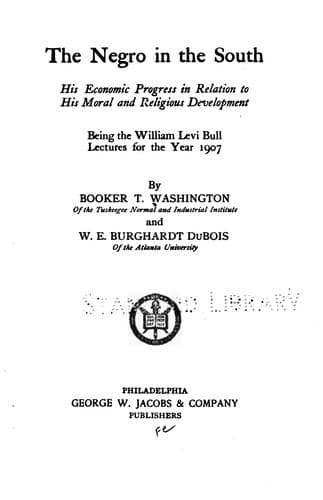
The Negro in the South: His Economic Progress in Relation to his Moral and Religious DevelopmentDu Bois, W. E. B. (William Edward Burghardt)
History
The Negro in the South: His Economic Progress in Relation to his Moral and Religious Development
Du Bois, W. E. B. (William Edward Burghardt)
African Americans -- Southern States
Albion W. Tourgee said: "They instituted a public school system in a
region where public schools had been unknown. They opened the
ballot-box and the jury-box to thousands of white men who had been
debarred from them by a lack of earthly possessions. They introduced
home rule in the South. They abolished the whipping-post, the
branding-iron, the stocks and other barbarous forms of punishment
which had up to that time prevailed. They reduced capital felonies
from about twenty to two or three. In an age of extravagance they were
extravagant in the sums appropriated for public works. In all that
time no man's rights of person were invaded under the forms of law."
Thomas E. Miller, a Negro member of the late Constitutional Convention
of South Carolina, said: "The gentleman from Edgefield (Mr. Tillman)
speaks of the piling of the State debt; of jobbery and peculation
during the period between 1869 and 1873 in South Carolina, but he has
not found voice eloquent enough nor pen exact enough to mention those
imperishable gifts bestowed upon South Carolina between 1873 and 1876
by Negro legislators--the laws relative to finance, the building of
penal and charitable institutions, and, greatest of all, the
establishment of the public school system. Starting as infants in
legislation in 1869, many wise measures were not thought of, many
injudicious acts were passed. But in the administration of affairs for
the next four years, having learned by experience the result of bad
acts, we immediately passed reformatory laws touching every department
of state, county, municipal and town governments. These enactments are
to-day upon the statute books of South Carolina. They stand as living
witnesses of the Negro's fitness to vote and legislate upon the rights
of mankind."
Cf. Love's "Disfranchisement of the Negro," p. 10.
NOTE 9
Cf. "The Economic Future of the Negro," in papers and proceedings of
the eighteenth Annual Meeting, American Economic Association, pp.
219-42.
NOTE 10
See Alabama Laws on Labor Contracts.
NOTE 11
See Laws of Alabama, 1906-1907.
NOTE 12
See Laws of South Carolina, 1906-1907.
NOTE 13
Cf. Bulletin Number 8, 12th United States Census.
NOTE 14
This statement when made was challenged by a Virginia rector. Let John
Sharp Williams, minority leader of the House of Representatives answer
him.
Public-domain text, read in full here on John Shaqi.
Reviews
Reviews
No reviews yet
Be the first to share your thoughts on this work.
Elsewhere in the archive
Join the Discussion
Join the discussion
Sign in to leave a comment or review.
Sign InorCreate an account