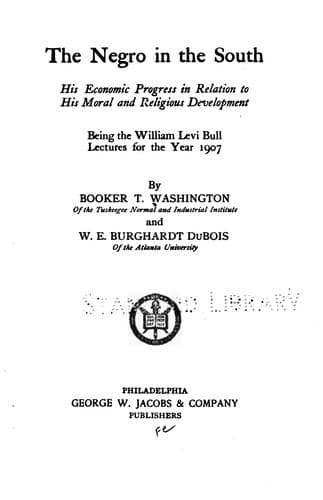
The Negro in the South: His Economic Progress in Relation to his Moral and Religious DevelopmentDu Bois, W. E. B. (William Edward Burghardt)
History
The Negro in the South: His Economic Progress in Relation to his Moral and Religious Development
Du Bois, W. E. B. (William Edward Burghardt)
African Americans -- Southern States
"It is the physical presence of the Negro which constitutes the Negro
problem and the race issue. It is not the fact that the Negro can vote
in the South, because, as a matter of fact, he cannot and does not.
The Negro problem would be just as troublesome as it is to-day if the
fifteenth amendment were repealed. The fifteenth amendment touches it
only on its political or voting side, where the trouble is cured
already in the South. It is true that the Negro does vote in Ohio,
Illinois and New Jersey and various other places. But the people of
those states could to-morrow, if they wanted to, get rid of his vote,
just as we have got rid of it in Mississippi. The very fact that they
have not done it is proof of the fact that they do not want to do it,
and that very fact is the death-blow of the Vardaman agitation."
Negroes are disfranchised by legal and illegal methods and by unfair
administration of the law. The "white" primary is a wide-spread
subterfuge: to the democratic primary election all white men are
admitted without question, and no Negro under any circumstances. The
verdict of the primary is then registered in a farce "election." In
Atlanta, _e.g._, at the "election" 700 votes are cast in a city of
100,000! The success of the "white" primary depends of course (_a_) on
the illegal power of the party chiefs to exclude any votes they choose
on any pretext and (_b_) on the absolute and unfair control of
election machinery and returns by one party and (_c_) on public
acquiescence in this travesty on popular government.
NOTE 15
The Atlanta riot had two distinct phases: first, Saturday, the killing
of innocent and surprised Negroes by a white mob; then a lull when
blacks rapidly armed themselves; finally the attempt to renew the
assault by a crowd mingled with county policemen, who were repulsed by
a fierce defense by Negroes; these Negroes were afterward acquitted of
murder by a southern jury. The number of white and black killed in
that encounter will never be known, but it stopped the riot. Cf.
"World To-Day," Nov. 1906.
NOTE 16
The executive officials of the miners in Alabama consist of four
whites and four Negroes.
NOTE 17
Ten good references on the economic history of the Negro and slavery
are:
1. Kemble, Fanny, "A Journal of a Residence on a Georgia Plantation,"
N.Y., 1863. 337 pp. 12mo.
2. Olmsted, F.L., "A Journey in the Sea Board Slave States," N.Y.,
1856. 723 pp. 12mo.
3. Cairnes, J.E., "The Slave Power: Its Character, Career, and
Probable Designs," London, 1862. 304 pp., 2d ed. N.Y. 410 pp.
4. United States 12th Census, Bulletin No. 8: "Negroes in United
States," by W.F. Wilcox and W.E.B. DuBois, Wash., 1904, 333 pp.
5. "The Philadelphia Negro" (Publications of the University of
Pennsylvania) 520 pp. Ginn.
6. "The Suppression of the Slave Trade" (Harvard Historical
Monographs, No. 1) 335 pp. Longmans, 1896.
7. Atlanta University Publications:
No. 3, "Efforts for Social Betterment," 66 pp. 1898.
Public-domain text, read in full here on John Shaqi.
Reviews
Reviews
No reviews yet
Be the first to share your thoughts on this work.
Elsewhere in the archive
Join the Discussion
Join the discussion
Sign in to leave a comment or review.
Sign InorCreate an account