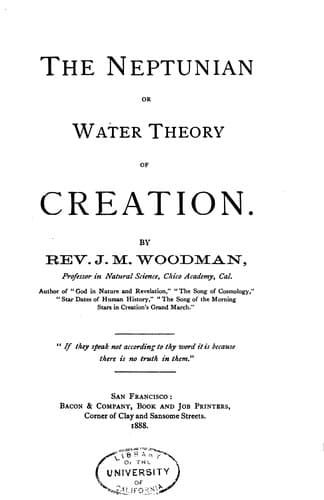
The Neptunian, or Water Theory of CreationWoodman, J. M.
Religion
The Neptunian, or Water Theory of Creation
Woodman, J. M.
Bible and science; Creation; Religion and science
1. Like Homer, who dated his poem in the rising of the star Sirius, so
Job dated his book in the Pleiades, while the sun was gaining his vernal
equinox in the star Alcyone of this constellation. The Septuagint speaks
of Job’s age at the commencement of his trial as being one hundred
years. By the closing statement appended to his book, we learn that he
lived after his restoration one hundred and forty years. This makes his
age two hundred and forty at his death. Alcyone marks by precession of
the equinoxes 2100 years B. C. The great period of his longevity
indicates a time antedating Abraham’s day by more than two hundred
years.
2. This book is an epi-dramatic Oratorio of human history. It is epic,
in that it gives the history of a real life; dramatic, in that it
dramatizes human history, by the inspirations of these actors, with the
religious intuitions of all ages. The poem as a whole shows the
contending forces that develop character; the struggle of man’s redeemed
nature against the tendencies of a series of degenerate ages, as far
down as the full triumph of Christ’s reign; followed by the long
prosperity that awaits the Church. It also sets forth the longings of
the human intellect for a knowledge of first causes; and its crowning
success when Nature is studied in connection with the revelations of
God’s Word. The Book of Job was evidently the only Scripture that the
world had for at least eight hundred years. The introduction shows Job
to have been a person adapted to great reverses of fortune, rich, pious,
prosperous, happy, and respected. Two spirits, either of which may take
form, but neither being dependent on form or locality, are present in
their religious gatherings as they have ever been in ours. That
objective figures come before our imaginations in reading this part of
the poem, only shows the high character of the production.
3. The first question between God and Satan is that hackneyed one of all
history, viz: Is piety a selfish ebullition of the human heart or a
divinely planted principle? Satan takes the first statement, God the
latter. Satan affirms that a sudden reverse of fortune will change the
aspect of Job’s piety, and he will then curse God to his face. Great
principles are best tested by suffering. Nor is it necessary that every
one should suffer in the same direction to show forth the same. The
world is full of delegated suffering; the few for the many, and
sometimes one for all. Job is the right man in wealth, station,
influence, and habits of mind to personify piety in its relation to the
world’s progress.
Public-domain text, read in full here on John Shaqi.
Reviews
Reviews
No reviews yet
Be the first to share your thoughts on this work.
Join the Discussion
Join the discussion
Sign in to leave a comment or review.
Sign InorCreate an account