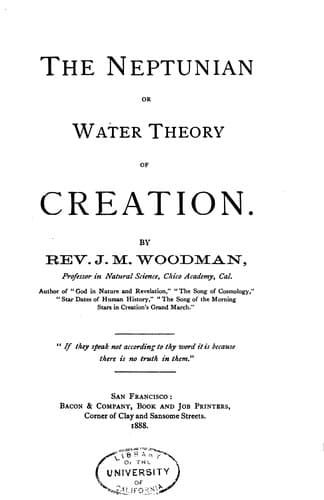
The Neptunian, or Water Theory of CreationWoodman, J. M.
Religion
The Neptunian, or Water Theory of Creation
Woodman, J. M.
Bible and science; Creation; Religion and science
4. The Orient is the place, and that period of the world the time, for
the rich figures of speech found in the two scenes of this unparalleled
production. Of the two forces meeting us in life, inviting our attention
and co-operation, one must and but one can, at the same time, receive
our homage. The one inclines you to and gives you credit for all good;
the other inclines you from and gives you no credit for any good. The
princely man of the Orient is suddenly confronted with absolute
bankruptcy and bereavement of all his children, without the chance of
speaking the parting good-bye. Satan expected the question settled in
his favor, by a sudden outburst of passion, in vindictive hate to God.
But listen! “Naked came I out of my mother’s womb (earth), and naked
shall I return thither. The Lord gave, and the Lord hath taken away;
blessed be the name of the Lord.” The first scene is ended with Satan
completely foiled. But, some one might say, the question only covered
Job’s outward prosperity. True, his wife is left to him, but she is a
part of himself.
5. Again the sons of God are together in worship. Satan begs leave to
amend his indictment against piety. “Touch his bone and his flesh and he
will curse thee.” Job is smitten in a manner calculated to break down
his patience. The patience of his wife having become exhausted, she is
influenced to give her vindictive advice in the line of Satan’s desires,
“Curse God, and die.” “Thou speakest as a foolish woman. What! shall we
receive good at the hand of God, and shall we not receive evil?”
6. The prologue of scene second ends with Satan confounded. The incoming
circumstances show God’s present proposition to be that true piety will
not only endure, without tarnish, what Satan in his ill will has
proposed, but it will survive and develop in strength in the ages to
come, until it shall triumph over every foe. To refute all satanic
charges to which history will give rise, God proposes to try it in this
person, under the leading intuitions governing the masses of all ages,
past and to come. Three supposed but mistaken friends hear of Job’s
calamity, and resolve to condole his misery. These are ranked within the
family of God’s sons. These men are kings in their time, and are
supposed to be entitled to a hearing. Their mistakes will make them
really Job’s enemies. Such are the coadjutors that Satan is about to
have brought to his aid. They find Job in keen anguish of body,
incapable of recognizing his friends.
7. These persons are all representative characters, whose intuitions
will partake of the nature of the epochs of human history, through which
the prophet Job is about to be taken. Job personifies piety; Eliphaz,
reverence in tradition; Bildad, special Providence as a rule of action;
Zophar, ignorance, the mother of devotion. Beginning with the fall of
man, each epoch of human history is to stamp the prevailing religious
intuitions of the masses upon these men.
Public-domain text, read in full here on John Shaqi.
Reviews
Reviews
No reviews yet
Be the first to share your thoughts on this work.
Join the Discussion
Join the discussion
Sign in to leave a comment or review.
Sign InorCreate an account