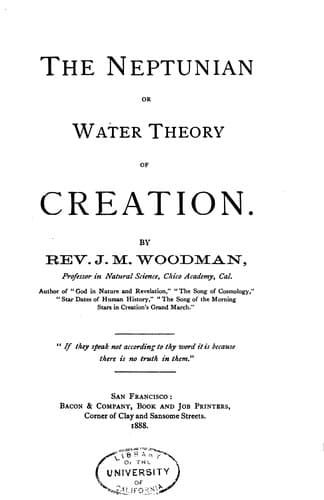
The Neptunian, or Water Theory of Creation — John Shaqi
The Neptunian, or Water Theory of CreationWoodman, J. M.
Religion
The Neptunian, or Water Theory of Creation
Woodman, J. M.
Bible and science; Creation; Religion and science
10. The flood is passed in chapter eight, and “man’s days become as a
shadow.” The law of God’s natural Providence, in cause and effect, is by
Job and his friends completely ignored. His own condition will look him
in the face with terrible effect, asking an explanation. To such an
ordeal, with Bildad framing an enthusiastic argument upon the evidences
of special Providence in the affliction, was Job brought. He can
logically prove Job to be one of the worst of men. “Doth God pervert
judgment?” To Job he saith, “If thou wast pure and upright, surely now
he would awake for thee.” Job with his intuitions cannot see why the
argument is not sound. “I know it is so of a truth.” To work thus upon
the nerves of a sick man, who has been shut off from comprehensive views
of God’s general Providence in law, is well calculated to break him down
in impatience toward God. But Job replies, “If I say I am perfect it
shall also prove me perverse. Though I were perfect, yet would I not
know my soul; neither is there any daysman betwixt us, that he should
lay his hand upon us both.” Zophar replied, “Know therefore that God
exacteth of thee less than thine iniquity deserveth.” Job replied, “I
could speak as you do if I were in your stead.” “Though he slay me, yet
will I trust in him.” Job claims an honest integrity of purpose, though
denying perfection in attainment.
10. For this noble stand he is rewarded on the spot with a prophetic
view of what forms the first chapter in the “Little Book” of star-dates.
Tracing time back by the precession of the equinoxes to where the sun
crossed its spring equinox in Orion’s belt, he saw the commencement of
man. Tracing the same line forward to the end of our race, where indeed
time ends, he saw that it rested in Ash or the Great Bear (margin)
incorrectly translated Arcturus; new version, Great Bear.
Looking to the same kind of date of his own time, he saw the sun
crossing the Pleiades. Looking at the full inauguration of Christ’s
Kingdom on earth, represented by the termination of Job’s own
sufferings, he saw the time measured in the Summer Solstitial colure
going from under the Altar. “Thou madest Ash, Orion and the Pleiades,
and the chambers of the south.” Here commences the “Little Book,”
alluded to so often in prophecy, with four of the most important dates
of history, but sealed upon the back part until the opening of the same
by the “Lion of the Tribe of Judah” to his servant John. Here, perhaps
all unconscious of their bearings on future history, he is picturing in
the heavens, and dating by means of the precession of the equinoxes, the
long periods, revolutions, changes and triumphs his sufferings were to
take him, followed by the long prosperity of the Church of Christ in the
latter day.
Public-domain text, read in full here on John Shaqi.
Reviews
Reviews
No reviews yet
Be the first to share your thoughts on this work.
Join the Discussion
Join the discussion
Sign in to leave a comment or review.
Sign InorCreate an account