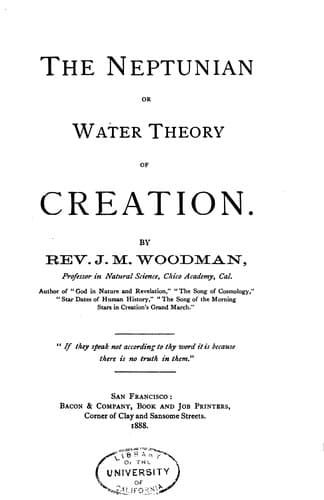
The Neptunian, or Water Theory of CreationWoodman, J. M.
Religion
The Neptunian, or Water Theory of Creation
Woodman, J. M.
Bible and science; Creation; Religion and science
11. Representing the reign of universal idolatry, and consequent
ignorance of the masses, and preceding the anxious inquiries concerning
immortality by Confucius, Socrates and Plato, Zophar is prepared to fill
in his part of the drama.
The question of the resurrection is discussed in the light of nature, in
Chap. 14. He is compelled to leave it as an open question, only wishing
that it might be true. “Oh that thou wouldest hide me in the grave, that
thou wouldest appoint me a set time, and remember me.” He nears the time
of the general expectation of Messiah’s appearance on earth.
He closes to allow Zophar, the representative of those Scribes and
Pharisees in their tradition, to speak again. This is found in the
fifteenth chapter.
12. From the sixteenth to the nineteenth, inclusive, Job personifies
Christ. Hence these chapters are Messianic. “They have gaped upon me
with their mouth, they have smitten me upon the cheek reproachfully. My
days are extinct, the graves are ready for me. God hath delivered me to
the ungodly, and turned me over into the hands of the wicked. Are there
not mockers with me? For thou hast hid their heart from understanding.”
Many of these sentences are quoted into the twenty-second psalm,
recognized by all commentators to be Messianic. This Special Providence,
as a rule to depend upon, watched Christ on the cross; it triumphed over
the fact that God did not deliver him.
Here it is in prophecy: “The snare is laid for him in the ground. It
shall devour the strength of his skin, even the firstborn of death, it
shall devour his strength. His confidence shall be rooted out of his
tabernacle. His remembrance shall perish from the earth. He shall be
driven from light into darkness, and chased out of the world. He shall
neither have son or nephew among his people.” Isaiah, quoting the
sentiment, asks, “Who shall declare his generation, for his life was
taken from the earth?”
The Messianic voice is personified from the grave. The grave speaks the
facts of history. “He hath put my brethren far from me, and my
acquaintance are verily estranged from me. My kinsfolks have failed, and
my familiar friends have forgotten me. They whom I loved are turned
against me. Why do you persecute me as God?” In the nineteenth chapter
Job has reached the resurrection. How changed the voice! “Oh, that my
words were now written! Oh, that they were printed in a book! That they
were graven with an iron pen, and lead in the rock forever.”
Public-domain text, read in full here on John Shaqi.
Reviews
Reviews
No reviews yet
Be the first to share your thoughts on this work.
Join the Discussion
Join the discussion
Sign in to leave a comment or review.
Sign InorCreate an account