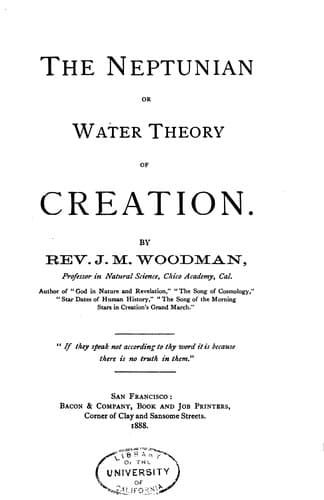
The Neptunian, or Water Theory of Creation — John Shaqi
The Neptunian, or Water Theory of CreationWoodman, J. M.
Religion
The Neptunian, or Water Theory of Creation
Woodman, J. M.
Bible and science; Creation; Religion and science
13. “For I know that my Redeemer liveth, and that he shall stand at the
latter day upon the earth. And though after my skin worms destroy this
body, yet in my flesh shall I see God.” Ignorance is not satisfied with
the report “that he is risen from the dead.” “The triumph of the wicked
is short. Though his excellency mount up to the heavens, yet he shall
perish forever. He shall fly away as a dream.” The days of apostolic
teaching and suffering passed, Christianity debauched by a state
religion, ignorance again put forth as a dying gasp, a few platitudes in
defense of God and against piety. Chap. 20. Job answered by referring
man’s conduct in life to a future judgment. Chap. 21. Reverence in
tradition exhorted Piety to speedy repentance. Chaps. 23 and 24. Piety
is searching directly for the true God.
14. Special Providence, ignoring law, boasteth of his secular strength.
“Is there any numbers of his armies?” Here in the poem civilization
reached the dawn of the Reformation. Chap. 26. It begins in the line of
science. The rocks begin to speak. “Dead things are formed from under
the waters.” The orbicular motion and the present pole-pointing of the
Earth, according to the Copernican system, is seen. “He stretcheth out
the north over the empty place, and hangeth the Earth upon nothing.” How
exactly in accordance with the history of scientific reform, that this
knowledge should begin in small fragments of truth. A glimpse of the
ancient pole-pointing is seen. “He hath compassed the waters with
bounds, until the day and night come to an end”; or until the end of
light begins with darkness. He saw the great “change of times and
seasons” caused by the Noachian flood. “He divideth the sea with his
power, and by his understanding he smiteth through the proud. Lo these
are parts of his ways; but how little a portion is heard of him! but the
thunder of his power who can understand?”
Public-domain text, read in full here on John Shaqi.
Reviews
Reviews
No reviews yet
Be the first to share your thoughts on this work.
Join the Discussion
Join the discussion
Sign in to leave a comment or review.
Sign InorCreate an account