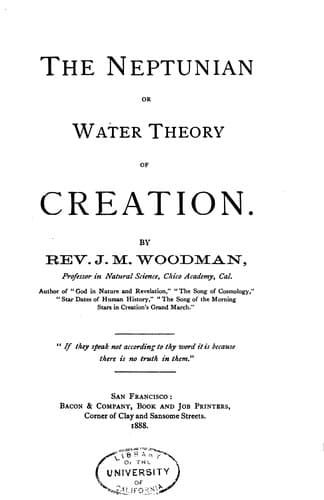
The Neptunian, or Water Theory of CreationWoodman, J. M.
Religion
The Neptunian, or Water Theory of Creation
Woodman, J. M.
Bible and science; Creation; Religion and science
10. They were designed to give two mornings of inorganic changes of
matter, with two contrasting evenings; two organic changes, as mornings
of vegetation, with contrasting evenings; two organic changes, as
mornings of animals, with contrasting evenings. These days are all
spoken of as noting a beginning, a middle, and a close. The beginning
and close are contrasts. This mode of measurement may have been derived
from Job 9:9—“Which maketh the Bear, Orion, and Pleiades.” Here is
Orion, marking the colure line of the Spring equinox at the creation of
man; the Bear, marking the same Spring equinox at the end of time; and
Pleiades, marking the date at which these visions came to the prophet.
Thus we have the beginning and ending of the human race in contrast, and
a middle date of passing events. Thus, with Moses the vision of creation
opens with the creation of all matter, and the first day ends with the
morning of light. The inertia of rest in chaos intervened. The Earth,
without form, and the Earth, in form, is contrasted, the second day,
with a separated firmament of the sun intervening. In the third day, we
have evening commencing with two gases in the form of a steam globe,
contrasted with the waving forests of the Devonian age of geology, with
the millions of years of deposits of inorganic substance intervening.
The language explaining the fourth day seems to be about the sun, moon,
and stars. But that these might shine in on the Earth, there was
involved the idea of removing the Earth’s “swaddling band,” alluded to
by Job. Hence the language involves an evening of twilight in which
Cryptogams, as the beginning of Earth’s vegetation, would contrast with
the flowers basking in clear sun light, while the slow process of how
God caused the sun to shine in on the Earth, by working this dark band
of gases into its crust, intervened. Nowhere is this rule seen so
clearly as in the language pertaining to the fifth day. Here, the
infusoria of the sea is made to contrast with the whale; while birds
intervene. These diatoms began in the deposit of the Gneiss rock. The
whale is found in the Myocene and since. The solitary reign of beasts is
noted as evening, contrasting with the reign of God’s people as “priests
and kings unto God,” at the close of time. Intervening are the events of
human history. Thus, every day of the six is shown by contrasts.
11. A general providence runs in law, evolving progress as far as
Nature’s law is adapted; but when Nature fails to meet any new want,
special providence steps in, with additional forces to supply the
deficiency. Space was an empty nakedness, and God created matter
therein. Matter was without form and void, and God started it in motion.
Matter was without life, and God created the life. The beasts of the
field were without a moral spirit. And God made man in his own image,
blessed with immortality, and capable of attaining to eternal life. For
farther particulars, see Sec. 4.
Public-domain text, read in full here on John Shaqi.
Reviews
Reviews
No reviews yet
Be the first to share your thoughts on this work.
Join the Discussion
Join the discussion
Sign in to leave a comment or review.
Sign InorCreate an account