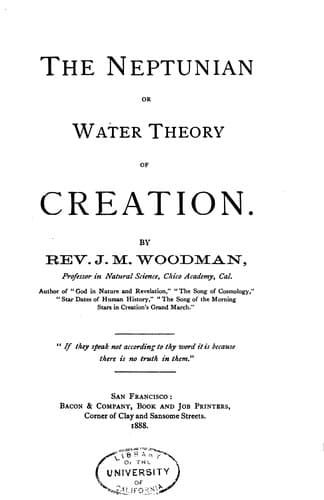
The Neptunian, or Water Theory of CreationWoodman, J. M.
Religion
The Neptunian, or Water Theory of Creation
Woodman, J. M.
Bible and science; Creation; Religion and science
CHAPTER IV.
The Phenomena to which allusions are so freely made in the “Six
Days of Moses,” suggest certain scientific necessities, replete
with geological information, which demonstrate the progressive
work of God, for matter, in matter, by and through matter,
and above matter, to the end of time.
Two books give a revelation of God, Nature and the Bible. Except for
purposes of intelligent connection, as a rule, the revelations of one
are not repeated in the other. Revelation on the subject of cosmos is
evidently intended to supply parts, which nature is not adapted to
unfold. Each stands as a part of a great whole; that the true student of
nature may be thoroughly furnished with proper text books, which, when
rightly understood, are conjointly harmonious, connected, and
exhaustive. If man would attain even the faintest ability to measure the
“footprints of God” in nature, or fathom the relation of first causes in
creation, he can ill afford unacquaintance with either book. The Bible
is given as a supplement to God’s voice in nature. Creation, shown in
harmony with the testimony of the rocks, confirms the testimony of
Moses. The unsupported hypotheses of men have led some to deplore the
“mistakes of Moses.” A better acquaintance with both books will lead
them, it is thought, at least to respect his great prophetic knowledge,
in outlining creation’s origin and forces.
Section 1.
The Work of the First Day.
1. The account, given in Genesis, of creation is in the form of an Epic
Poem. As a treatise on any subject, it would be incomplete. Its design
seems to be to give, in the form of poetic suggestions, the connecting
links to unite creation with creation’s God. For such a purpose, it is
the grandest and most complete of all productions of the pen. Six of
these days are marked by contrasts, “called evening and morning” but the
seventh is peculiar, having neither. The sixth is said to close God’s
labor with matter. Unmeasured duration is, doubtless, the seventh.
2. The “deep,” when used in reference to the heavens, means immensity of
space; as: “darkness was upon the face of the deep.” Darkness is the
normal state of space. Not dependent on matter, it is eternal. Moses saw
all matter created at once. God’s work, as revealed here for matter, is
in harmony with correlation of matter in science.
3. By a beautiful figure of metonymy, poets speak of a part implying the
whole. Such is the word “Earth,” as first introduced in this production.
“And the earth (all matter) was without form.” Inertia holds all in
rest. An act, fiat, or work of God, above matter, is requisite, to set
it in motion. “And the Spirit of the Lord moved upon the face of the
deep.” A system formed with a center of light is noted. All systems are
members of this choir.
Public-domain text, read in full here on John Shaqi.
Reviews
Reviews
No reviews yet
Be the first to share your thoughts on this work.
Join the Discussion
Join the discussion
Sign in to leave a comment or review.
Sign InorCreate an account