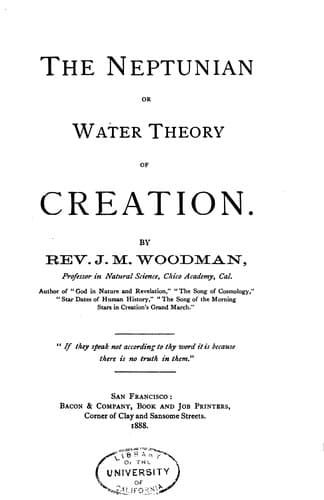
The Neptunian, or Water Theory of CreationWoodman, J. M.
Religion
The Neptunian, or Water Theory of Creation
Woodman, J. M.
Bible and science; Creation; Religion and science
4. Science would suggest, that, if a ponderous globe, as our sun, should
gather in a field of gases, though trillions of miles in diameter, all
gases, within its drawing sphere, must either go toward the sun, or be
thrown around it in a circle. Such was the ring of waters, or fluids,
first called a firmament. A most minute directing of Providence is here
suggested. It extended to each molecule of gas, and its appropriate
place was determined. Before that grand movement of the Spirit of God,
there was nothing with which to measure duration, and time had not
commenced. No centers—no gravitation. No motion—no light or force. All
this is suggested in matter “without form.” Suns only had form at the
close of the first day. As systems revolved, measured duration might
have commenced at the revolutions of suns about a grand center. One day
at the sun would be twenty-seven of ours; one year, eighteen thousand of
ours. This first day of creation may have been one hundred million of
years. It included the length of these contrasts to a climax,
darkness—light. The one reigning over all matter, the other forming from
matter, under the direction of God.
5. If the first is a literal day, so are the seven. If the first is
poetic, so are the seven. That the first was not literal, is evident in
that the “Earth was without form” as yet. Hence there was no twenty-four
hour measurement. Day is also used to signify a nation’s history. It is
not that. It is also used to signify the life of an individual. It could
not be that. “A day with the Lord is as a thousand years.” It is evident
that Peter was merely hinting at the indefiniteness, as to time, of the
Mosaic days. It remains, then, that it is a cosmological day, without
exact measurement of time. It certainly includes all that period of
chaotic darkness before time commenced. Should these gases move across
the radii of our system with the speed of light, it would take
thirty-five days; but should the gases move like an atmosphere in space,
it would take more than ninety million of years to gather the sun. The
greater probability is that these contrasted conditions of the first
day, poetically described without any exact measurement, if measured,
would extend through more than one hundred million of our years.
Section 2.
The Work of the Second Day.
Public-domain text, read in full here on John Shaqi.
Reviews
Reviews
No reviews yet
Be the first to share your thoughts on this work.
Join the Discussion
Join the discussion
Sign in to leave a comment or review.
Sign InorCreate an account