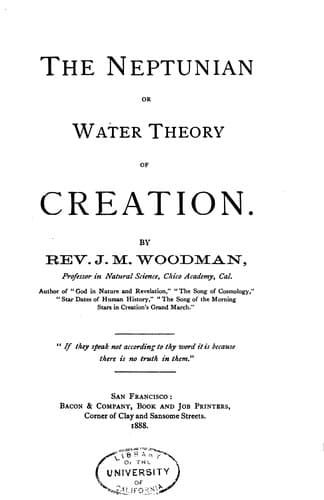
The Neptunian, or Water Theory of CreationWoodman, J. M.
Religion
The Neptunian, or Water Theory of Creation
Woodman, J. M.
Bible and science; Creation; Religion and science
3. The more popular teaching of today is, that matter existed in a
highly heated state in the form of a diffused cloud. Steel, in his
“Fourteen Weeks in Geology,” suggests that “From unknown causes, this
cloud-matter began to revolve about a center or sun. This nucleus drew
matter direct to itself from all parts of our system. Other portions
revolving were thrown off, and formed new centers for planetary
gathering, as they respectively took up their orbicular march about the
sun. This fiery mist is supposed to have come together in a heated
state. The planets, at least, have since been cooling, though as yet
having but a thin crust.” To this theory of primeval heat, in some form,
all our text books conform. A theory so long and so universally accepted
might be supposed to have some solid facts upon which to rest. But
really it has less to sustain it than had the Ptolemaic theory of
Astronomy: that, at least, had observation in its favor, but this fails
even here. It is a curious circumstance in this guess work of results,
that whether heat is made to increase on an average one degree in fifty
feet, as given by many geologists, or one degree in one hundred feet, as
given by others, precisely the same results are reached, viz., fifty
miles crust, and intensely heated matter beyond. This assumption is
based upon the supposed fact that the internal heat traverses the rock
by conduction. If this were true, then the degree of heat gained in any
one hundred feet of rock, as you descend into the Earth’s crust, would
be the approximate measurement of any other hundred feet in the same
shaft; but the reverse of this is true. No two measurements seem to be
alike. The miner, as a practical geologist, in this regard knows that
this heat is generally caused by chemical action of the rock upon which
you have let in air or water, or both. This heat is found to vary
according to nature of the rock which you expose. If the rock is rich in
pyrites of iron or lime, in any of its numerous forms, then
disintegration is abundant and much heat is generated; but, on the other
hand, where all disintegrating elements are wanting, there is no
perceptible increase of heat.
Public-domain text, read in full here on John Shaqi.
Reviews
Reviews
No reviews yet
Be the first to share your thoughts on this work.
Join the Discussion
Join the discussion
Sign in to leave a comment or review.
Sign InorCreate an account