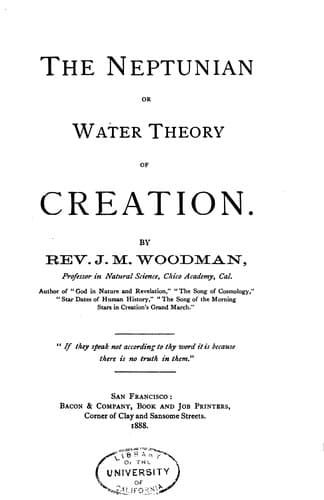
The Neptunian, or Water Theory of CreationWoodman, J. M.
Religion
The Neptunian, or Water Theory of Creation
Woodman, J. M.
Bible and science; Creation; Religion and science
4. The theory of the continued increase of heat, according to the ratio
noticed as you sink a shaft a few hundred feet into the Earth’s crust,
if it proves anything proves too much, and is therefore false.
Experiments extensively made in the Virginia mines of Nevada, and
particularly in the Foreman Shaft, show the increase to be very uneven;
differing from one degree in twelve feet to one in two hundred feet. It
even grows colder as you descend some kind of rock, a degree in one
hundred feet. The degree of heat is always regulated and gauged by the
rock you pass. If the rock will disintegrate readily, it gives out more
heat; but if the rock may lie exposed in the sun and rain without
disintegration, it throws out no heat in the shaft. Yet from experiments
made in the Foreman Shaft, notwithstanding these varieties of rock, yet
at the 2,100 foot level it is found that the average increase is one
degree in twelve feet. At this rate, at twenty-five miles towards the
center you would encounter heat above 4,300 deg. Fahr. Chemists will
admit that, after due allowance for pressure at such a depth, yet the
granite with all known substances would fuse at this heat. The Plutonic
hypothesis makes the crust in Nevada less than twenty-five miles,
perhaps the weakest on the continent.
Experiments in Mexico, upon this line of reasoning, would make the crust
twice as thick. Now from a well established law in philosophy, a
pressure upon liquid on the inside of a cylinder imparts its pressure to
every part of the cylinder at the same time. A pressure capable of
breaking the crust in any place should, at least, cause all the openings
to emit lava at the same time. But this is not the historic action of
volcanoes; one emits while another sleeps.
It is a historic fact observed within the present century, that a
volcanic mountain rose up from a comparatively level plane in Mexico, in
one night, to the height of 1,695 feet. On the assumption that lava
comes from the center of the earth, why should not the above pressure
have found the weaker crust, and Nevada have been the place of eruption
instead of Mexico? and why should not the three hundred open vents of
Earth have emitted lava at the same time? The theory will not bear
philosophic tests.
The Russian report of the increase of heat is only one-fourth that given
in Nevada. Who believes, therefore, that the crust there is four times
as thick as in Nevada? The whole subject shows that the increase of heat
in the shaft proves nothing as to the interior of Earth, and nothing as
to the thickness of its crust.
Public-domain text, read in full here on John Shaqi.
Reviews
Reviews
No reviews yet
Be the first to share your thoughts on this work.
Join the Discussion
Join the discussion
Sign in to leave a comment or review.
Sign InorCreate an account