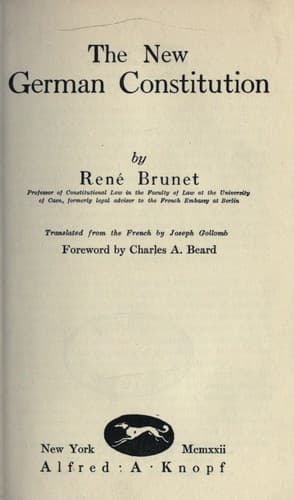
Germany -- Politics and government -- 1918-1933; Germany. Verfassung (1919)
3. _The Reich encroached more and more on the domain of the individual
states._ This encroachment, this evolution toward unitarism, manifested
itself in most divers ways. In military matters it took the form of a
fusion of fighting contingents which belonged more or less nominally to
the various states, but which, with the exception perhaps of Bavaria,
placed their whole force at the direct command of the Emperor. As for
Bavaria, at the outbreak of the war its “reserved rights” had almost
completely disappeared. The development of the legislation of the
Empire had accentuated this evolution toward unitarism. In the measure
that the Reich legislated in a large number of domains, it wiped out
in these matters the different regulations that existed up to then in
the individual states. It is true that the execution of the national
legislation was entrusted to functionaries within these states; but these
officials were under the control of the Bundesrat and subject to the
supervision of the Reich. Even in financial matters the liberty of the
individual states was more and more limited. While it is true that they
conserved their autonomy in matters of duties and taxes, the more the
Reich discovered new sources of revenue the more the legislation of the
Empire imposed on the several states the task of collecting this revenue
and the more narrow became the scope in which the states could manage
their own financial affairs, and the dependency of the states grew the
more on the financial legislation and the budgetary dispositions allowed
them by the Reich.[3]
Public-domain text, read in full here on John Shaqi.
Reviews
Reviews
No reviews yet
Be the first to share your thoughts on this work.
Join the Discussion
Join the discussion
Sign in to leave a comment or review.
Sign InorCreate an account