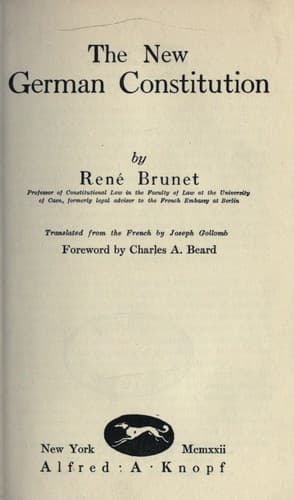
Germany -- Politics and government -- 1918-1933; Germany. Verfassung (1919)
These states were governed by constitutions of the greatest variety.
There were three free cities, Hamburg, Bremen and Lübeck; twenty-two
monarchies, which carried different titles; Kingdoms--Prussia,
Bavaria, Saxony, Wurtemberg; Grand Duchies--Baden, Hesse;
Duchies--Saxe-Coburg-Gotha, Saxe-Meiningen; and Principalities--Waldeck,
Schaumburg-Lippe, etc.
Among these states some, a large majority but the least important, had
adopted the system of the single legislative chamber, which, with one
or two exceptions, comprised, beside the deputies elected by universal
suffrage, members named by the princes of the state, or by special
electoral colleges such as groups of the heaviest tax payers, chambers
of commerce, industrial and agricultural organizations, the clergy, the
professions, etc.
The other states, four kingdoms and the Grand Duchies of Baden and of
Hesse, had two chambers each. The upper house was almost entirely
composed of members of the reigning families or their kin and of
personages charged with representing the nobility or the great landed
proprietors. The lower house was elected sometimes by universal suffrage,
sometimes by a system of plural voting; or by a system that divided the
population in such a way that the voice of the people was nullified
almost entirely in favor of the big taxpayers as in Prussia.
All this would present an erroneous and incomplete picture if one did not
take the precaution to search beyond the letter of these constitutions
and inquire how the government of Germany was actually conducted. The
political institutions of Germany presented a certain number of aspects
which it is important to bring out clearly:[2]
1. _These institutions were anti-democratic._ It is true the Reichstag
was elected by universal and direct suffrage. But, on the one hand the
electoral legislation of the Reich contained certain provisions which
were singularly behind the times, such as the denial to the poor of the
right to vote, the fixing of the voting age at twenty-five, etc. On
the other hand, the Bundesrat, which was not elected, possessed powers
superior to those of the Reichstag; and the latter could do nothing
without the Bundesrat. The same situation existed within the individual
states, which either did not have a chamber elected by universal suffrage
or else limited it in power by the check of an upper house, feudal and
conservative in character.
2. _These institutions were anti-parliamentary._ The Reichstag could
interpellate the Chancellor but could not depose him. To a question or
to an interpellation the Chancellor was always free to respond that
he did not wish to reply; or he could fix his own time for replying;
and finally, if he was in the minority in the house he did not have to
resign.
Public-domain text, read in full here on John Shaqi.
Reviews
Reviews
No reviews yet
Be the first to share your thoughts on this work.
Join the Discussion
Join the discussion
Sign in to leave a comment or review.
Sign InorCreate an account