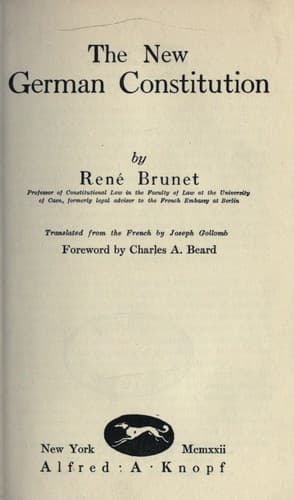
Germany -- Politics and government -- 1918-1933; Germany. Verfassung (1919)
But this government may assume different aspects, and the republic--for
we have seen that the republic is the normal form of democratic
government--may be organized according to three different principles.
There may be noted, according to the type, the _presidential republic_,
such as the United States of America, which tends to realize a separation
of powers as complete as possible and in which the President elected by
the people and his ministers or secretaries nominated by the President
are never responsible to the Parliament. Then there is the _collegiate
republic_, such as Switzerland and the Hanseatic Cities, in which
the President is replaced by a college which is, by the side of the
Parliament, an organ of popular sovereignty and which exercises executive
powers. This college is elected by the popular representative body and
depends on it. Finally there is the _parliamentary republic_, such as
exists in France.
We know what makes up parliamentary rule. Here also legislative
power and executive power are separated and are to a certain measure
independent. But the two cannot exercise their functions except when in
co-operation. On the one hand, a certain separation; on the other, a
certain co-operation, co-operation of separate and independent powers.
The functioning of this system is insured by a very simple mechanism.
The president names his ministers but these ministers cannot begin
functioning or remain as such until they have obtained the confidence of
the national representative body. The day that these ministers lose this
confidence they also lose their power. Parliament does not only exercise
legislative power therefore; it also controls executive action. The chief
of states names his ministers, but he has not the liberty to appoint
them. He must take those designated by the majority of the Chamber and
reject them when they are discarded by the Chamber.
It is this last system that the German Constitution has chosen. One may
express surprise thereat. For has not Germany been the classic ground
for pleasantries over “parliamentary cretinism”? However, it has chosen
parliamentarism. To use the words of Member of the Reichstag Koch, “The
best form of expression of democracy is parliamentarism. We know of
no other form superior to it and we have consequently decided to make
parliamentarism one of the foundations of the new edifice.”[33]
Now, the mechanisms which the Constitution has instituted, and through
which the parliamentary system must function, are--either because of
the federal form of the State, or because of new ideas which it has
introduced in its creation--more numerous and more complicated than in
most other countries. There is a Reichstag, a President, a Cabinet, a
Reichsrat, and an Economic Council.
Public-domain text, read in full here on John Shaqi.
Reviews
Reviews
No reviews yet
Be the first to share your thoughts on this work.
Elsewhere in the archive
Join the Discussion
Join the discussion
Sign in to leave a comment or review.
Sign InorCreate an account